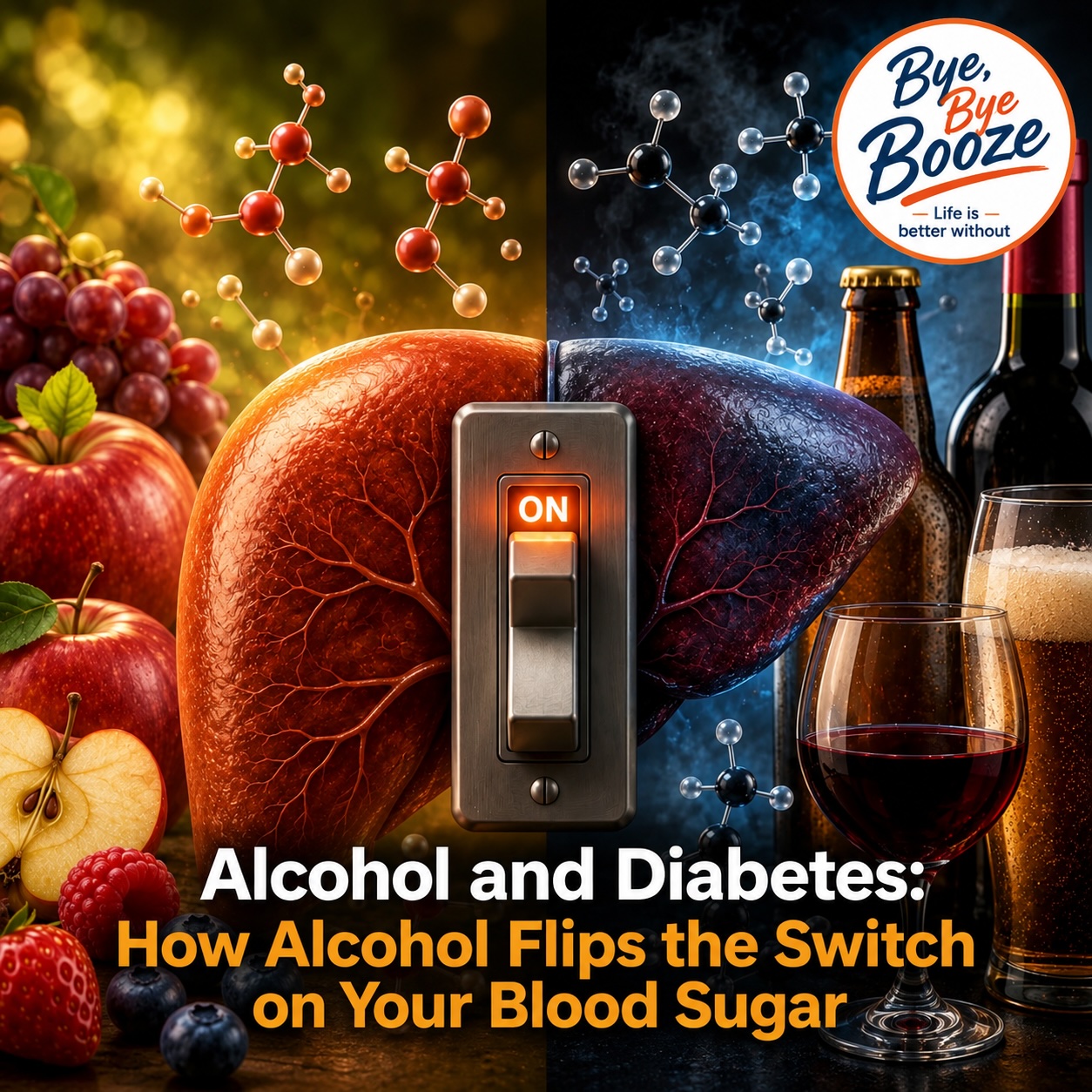
Alcohol and diabetes are more closely linked than most people think. New research shows that alcohol activates the same metabolic pathway as fructose—and doubles the risk of type 2 diabetes. Here’s the science behind it, and why that’s actually good news.

Thomas, 48, sales manager. Athletic, lean, no prior health issues. For years he’s been having his two or three beers every evening—no big deal, he figures. At a routine checkup, his doctor finds an HbA1c of 6.3%, the diabetes risk marker. Borderline. “Prediabetes,” the doctor says. Thomas is baffled. He barely eats sweets, follows a reasonably healthy diet. Where is this coming from?
The answer lies in a metabolic pathway that science has only recently begun to understand. To make sense of it, we need to take a step back—all the way to a time when neither beer nor chocolate existed.
An ancient switch—and why it once made perfect sense
Think of the body as a system optimized over hundreds of thousands of years for one thing: survival. Our ancestors had access to ripe fruit for just a few weeks in the fall—berries, figs, grapes. These fruits contain fructose, fruit sugar. And fructose was a signal to the body: Harvest time. Plenty of food. Store as much as you can—winter is coming.
The body responded to that signal with a full program: more hunger, more fat storage, less energy expenditure. Animals in the wild still use this mechanism today. Bears gorge themselves before hibernation. Migratory birds build energy reserves before the long journey. The trigger is always the same: fructose activates a metabolic switch.
Researchers at the University of Colorado, led by Richard Johnson and Miguel Lanaspa, have systematically decoded this switch over the past several years. In a comprehensive review in Nature Metabolism from spring 2026, they show that fructose is not just another calorie. It acts more like a metabolic signal—a hormone that tells the body: produce fat, become insulin resistant, prepare for scarcity.
In a world where fructose was available once a year for a few weeks, this worked perfectly. The stores were emptied again over winter. The switch turned on, and it turned off again.
The switch is stuck on “always on”
Today the situation is entirely different. Table sugar—sucrose, meaning glucose plus fructose—is everywhere: sodas, condiments, flavored yogurt, bread. High-fructose corn syrup, ubiquitous in the American food supply, delivers fructose on an industrial scale. Fruit juices marketed as healthy are concentrated fructose bombs. The switch that once kicked in for a few weeks a year is now flipped to “on” 365 days a year.
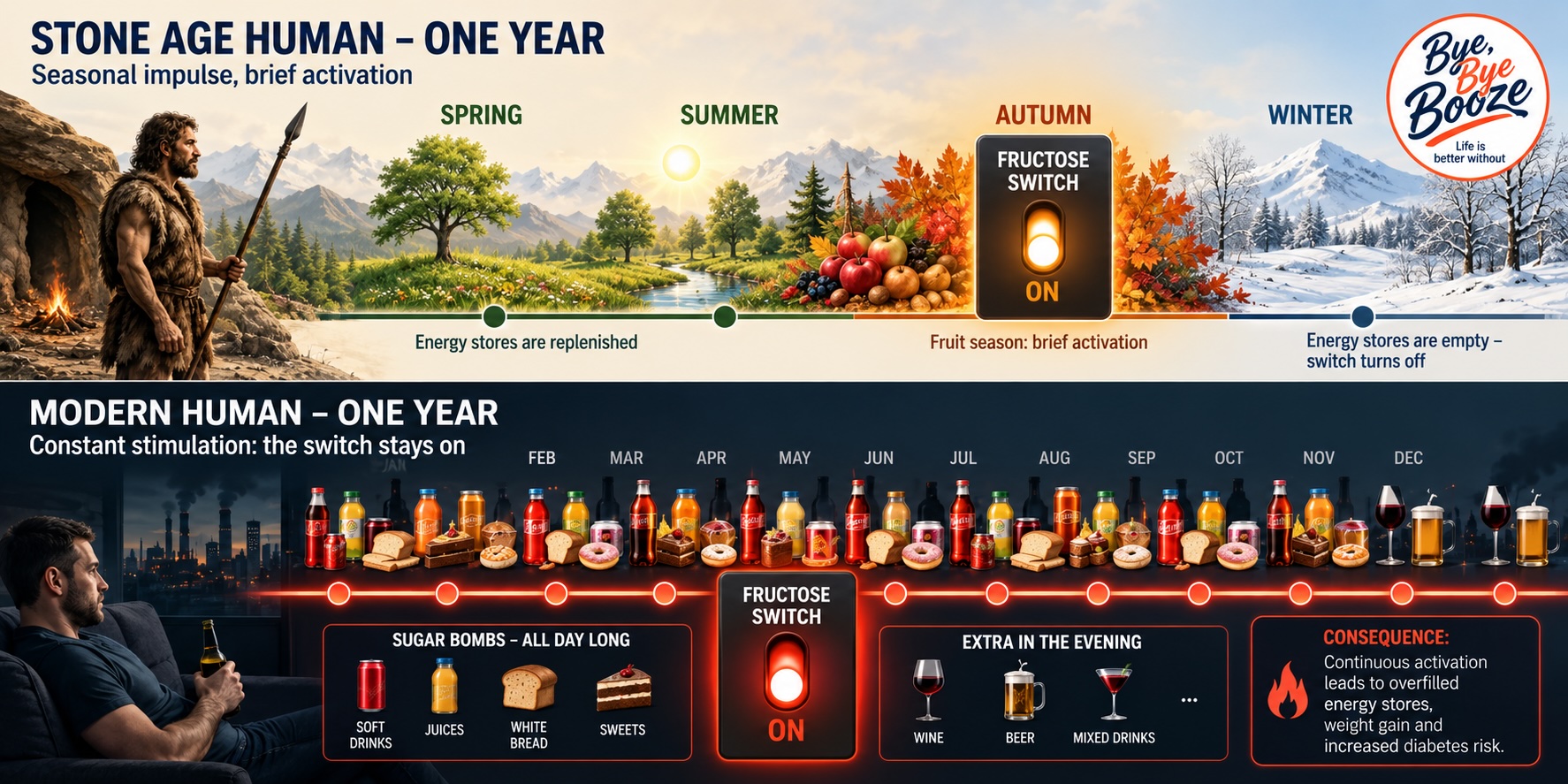
Infographic showing the “fructose switch”: The top half depicts a Stone Age year with the switch briefly activated by seasonal fruit in fall, followed by empty stores in winter. The bottom half shows year-round sugary foods and beverages plus evening alcohol keeping the metabolic switch stuck on “on” almost permanently.
And this is exactly where the problem begins: the liver metabolizes fructose through a special pathway that bypasses the body’s normal regulatory mechanisms. Unlike glucose, which is processed in an orderly fashion via insulin, fructose rushes straight into the liver and is broken down by an enzyme called ketohexokinase (KHK for short). In the process, something remarkable happens: the cell’s energy currency—the molecule ATP—is rapidly depleted. The cell behaves as if it were running low on energy, even though sugar is flooding in.
The result: the liver shifts into fat production mode. It builds new fatty acids, stores them—and in doing so, becomes fattier and fattier itself. A fatty liver develops. At the same time, insulin resistance increases: the body’s cells respond less and less to insulin, forcing the pancreas to produce more and more of it. Eventually it can’t keep up. That’s the moment when insulin resistance becomes type 2 diabetes.
So far, so familiar—at least for anyone who follows nutrition science. But now it gets really interesting. And ugly.
Enter alcohol: the body makes its own sugar
In November 2025, the same research team from Colorado published a study in Nature Metabolismthat delivered a missing puzzle piece. It shows that alcohol activates a metabolic chain in the body that causes it to produce its own fructose.
Read that again: the body takes in alcohol—and turns it into its own fruit sugar.
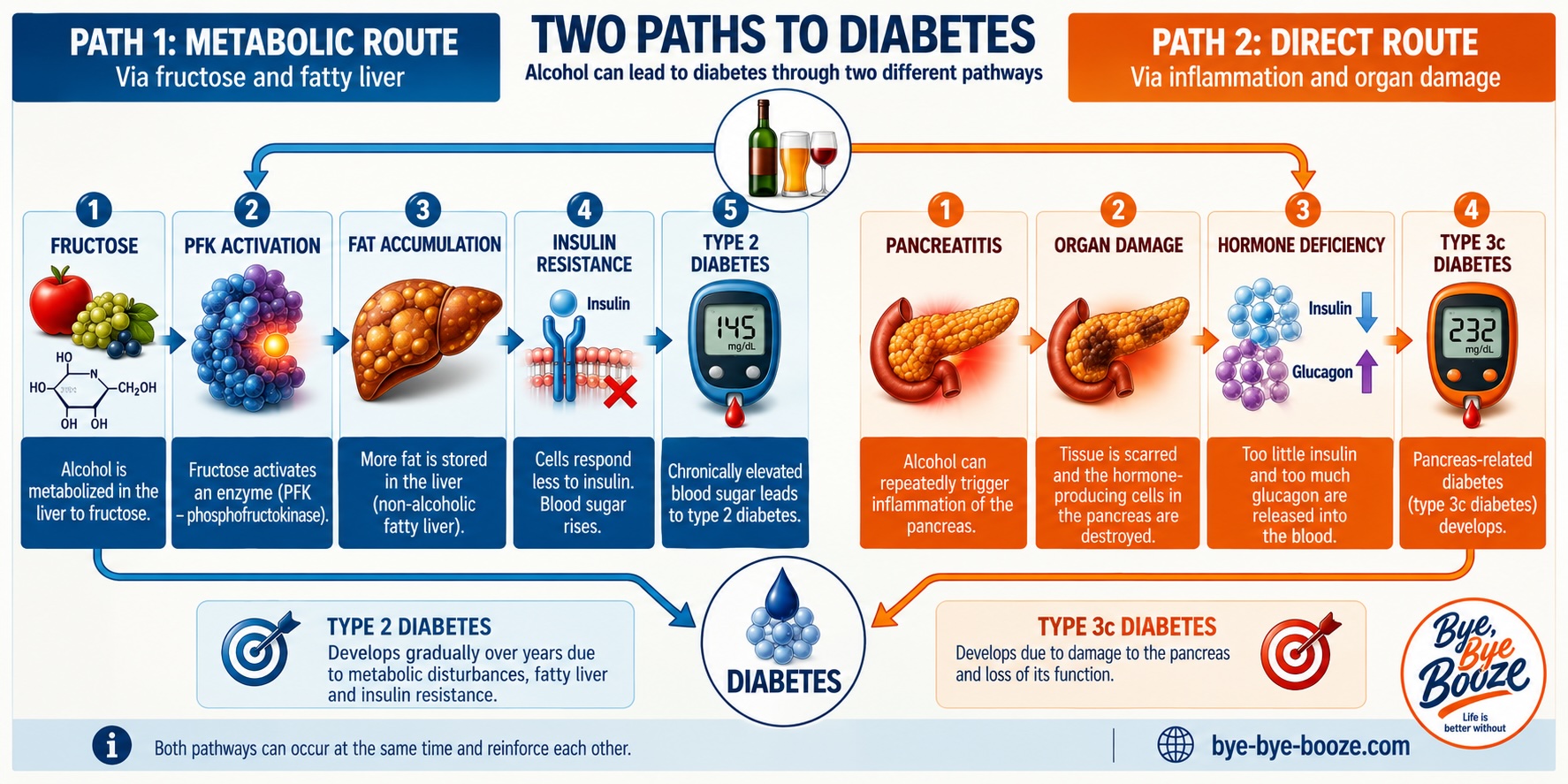
Infographic “Two pathways to diabetes”: The blue metabolic pathway leads from alcohol through fructose, KHK activation, and fatty liver to insulin resistance and type 2 diabetes. The orange pathway shows alcohol causing pancreatitis and organ damage with insulin and glucagon disruptions leading to pancreas-related type 3c diabetes. Both pathways can occur simultaneously and reinforce each other.
The pathway is called the polyol pathway. Alcohol increases the osmolality of portal vein blood (in plain terms: the concentration of dissolved particles rises). This activates an enzyme called aldose reductase, which converts glucose into sorbitol—and from there into fructose. This endogenous fructose is then broken down through exactly the same KHK pathway as the fructose from fruit or soda.
In plain English: alcohol pushes the same button as sugar. It uses the same switch that was once designed to help our ancestors survive the winter. Except now two fingers are pressing the button at the same time—the sugar from our diet and the alcohol from our evening drinks.
Even more striking was what happened when the researchers blocked this pathway: mice lacking the KHK enzyme showed significantly less interest in alcohol. They drank less, sought the reward less often—and their livers remained virtually unharmed. No fat accumulation, no inflammation, no fibrosis. The switch was off, and the damage didn’t happen.
Alcohol and diabetes: what the numbers say
What works in the lab has to prove itself in the real world. And the numbers are clear.
A large Taiwanese study followed more than 60,000 people with alcohol use disorder for up to 16 years—and compared them with an equally large control group carefully matched for age, sex, and preexisting conditions. The result: people with alcohol use disorder developed type 2 diabetes more than twice as often as the comparison group. The adjusted hazard ratio was 2.18. That means: even after accounting for all other risk factors, the risk remains more than doubled.
An interesting detail: the absolute numbers were higher in men—more men developed diabetes. But relative to their respective control groups, the risk increase was actually steeper for women with alcohol use disorder.
A 2016 meta-analysis had already shown that roughly one in eight people with problematic alcohol use has type 2 diabetes—among nearly 4,000 individuals studied, the prevalence was 12.4 percent. In the general population of comparable age groups, it runs between six and eight percent.
When both collide: alcohol plus diabetes
And as if that weren’t enough: a British study of more than 540,000 people with type 2 diabetes found that those who also had alcohol use disorder developed severe complications at dramatically higher rates. The risk of end-stage renal disease (kidney failure requiring dialysis) was nearly doubled, amputations increased by 78 percent, and strokes by 36 percent. Overall mortality was 2.1 times higher than for diabetics without an alcohol problem.
So alcohol doesn’t just increase the risk of getting diabetes—it also massively worsens the prognosis for people who already have it.
But isn’t a glass of red wine supposed to be healthy?
The famous J-curve—the idea that one glass a day lowers cardiovascular risk—has come under heavy fire in recent years. Mendelian randomization studies, which use genetic variants as a natural form of random assignment, find no protective effect from moderate alcohol consumption on cardiometabolic disease.
The problem with the older studies: the “abstinent” group often included former drinkers who had quit for health reasons, plus people who couldn’t drink because of other medical conditions. That made the nondrinkers look sicker than they actually were because of the missing alcohol—and the moderate drinkers healthier by comparison. Researchers call this the abstainer bias.
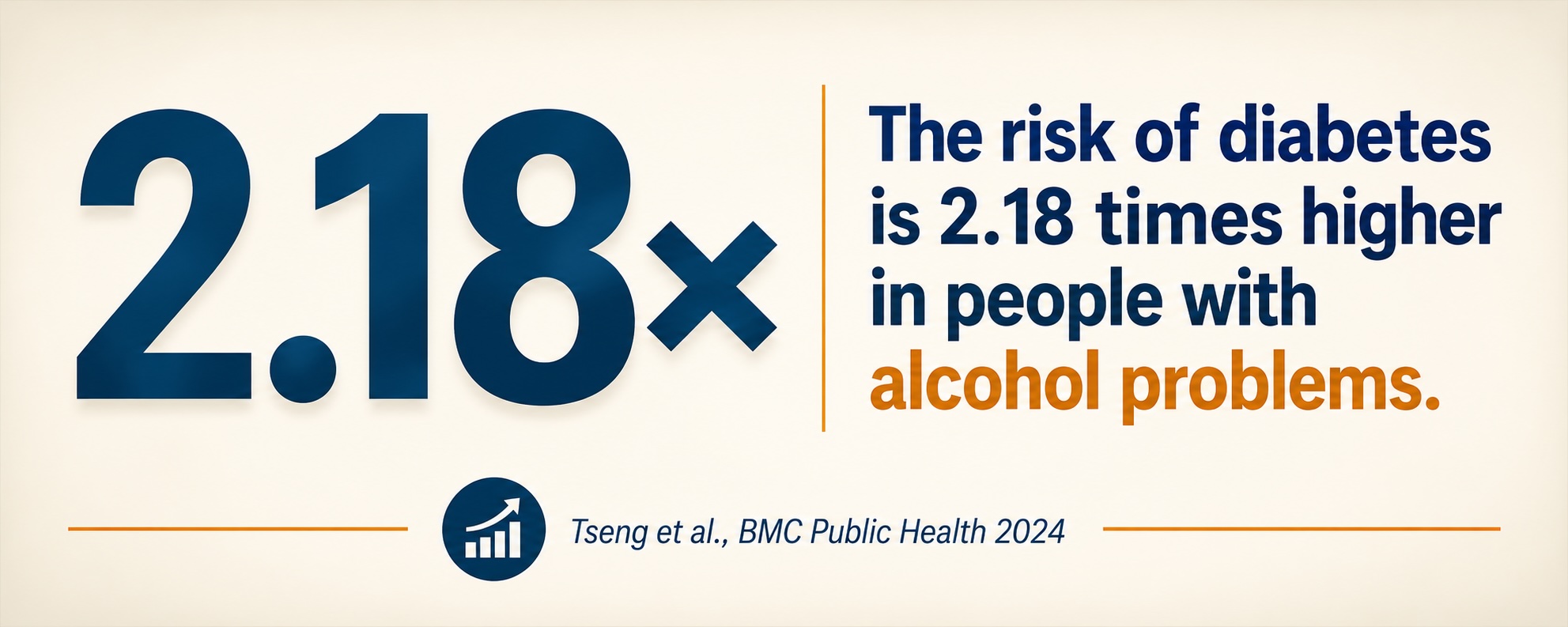
Large-scale display of the number “2.18×”—below it: “That’s how much higher the diabetes risk is with alcohol problems.” Small footer: Tseng et al., BMC Public Health 2024.
For type 2 diabetes, a recent review article shows: even where observational studies still detect a slight advantage for moderate drinkers, that finding applies only in the absence of episodic binge drinking—and is not supported by the genetic studies. The World Health Organization put it bluntly in 2023: there is no safe level of alcohol consumption.
Two pathways to diabetes—and what sets them apart
An important distinction: alcohol can lead to diabetes through two different pathways, and they are not the same thing.
The first is the metabolic pathway that this article is about: alcohol → endogenous fructose → insulin resistance → type 2 diabetes. It’s a slow, creeping process that builds over years, with fatty liver as a central waypoint.
The second pathway is direct organ damage: chronic alcohol consumption can inflame the pancreas so severely that it permanently loses its ability to produce insulin. The result is called type 3c diabetes—pancreatogenic diabetes.
Two different doors, same building. The metabolic pathway, however, affects far more people—because it doesn’t require severe pancreatitis to take hold. It kicks in with regular drinking, even without obvious organ damage.
What does this mean for you?
The blood sugar rollercoaster that many people in recovery know all too well—the trembling, the irritability, the sudden intense cravings for sweets or chips—has biochemical causes. Alcohol blocks the liver’s gluconeogenesis, its ability to quickly produce new glucose. At the same time, it drives insulin levels up via cortisol and sends blood sugar crashing. The body has learned that alcohol fixes this problem fast. A vicious cycle.
And now we know: on top of this cycle, alcohol also activates the fructose switch and drives insulin resistance from an entirely different angle.
The good news, though, is real: insulin resistance is reversible. When you stop drinking, you give your metabolism a chance to recover. The liver can regenerate, insulin sensitivity can normalize, visceral fat—the dangerous belly fat that many know as the “beer belly”—can be reduced. It doesn’t happen overnight. But it happens.
Every day without alcohol is a day the fructose switch doesn’t get pressed a second time.
Connect with others on the same path in our discussion forum.
Frequently asked questions about alcohol and diabetes (FAQ)
Does alcohol increase the risk of type 2 diabetes?
Yes. A large cohort study of more than 120,000 people shows that individuals with alcohol use disorder are more than twice as likely to develop type 2 diabetes—even after adjusting for other risk factors such as age, sex, and preexisting conditions.
Why does alcohol cause diabetes when it contains no sugar?
Alcohol is not a carbohydrate and contains no sugar. But it activates a metabolic pathway in the body through which endogenous fructose is produced. This fructose is broken down in the liver through the same pathway as fructose from food—driving fatty liver, insulin resistance, and ultimately diabetes.
Is alcohol-related insulin resistance reversible?
In many cases, yes. Insulin resistance develops gradually and can reverse with abstinence, a balanced diet, and exercise. The earlier alcohol consumption stops, the better the chances that metabolism returns to normal.
Does moderate drinking protect against diabetes?
Older observational studies suggested so. However, more recent genetic studies show that this effect is likely a statistical artifact caused by what’s known as abstainer bias. The WHO has recommended since 2023 that there is no safe level of alcohol consumption.
What is the difference between type 2 and type 3c diabetes in people with alcohol use disorder?
Type 2 diabetes develops through insulin resistance—the body’s cells stop responding properly to insulin. Type 3c diabetes results from direct damage to the pancreas, usually from alcohol-related pancreatitis, in which the organ loses its ability to produce insulin. Both can be triggered by alcohol, but through different mechanisms.
References for “Alcohol and diabetes: how alcohol flips the same switch as sugar”
- Andres-Hernando A et al. (2025): “Identification of a common ketohexokinase-dependent link driving alcohol intake and alcohol-associated liver disease in mice.” Nature Metabolism, 7(11), 2250–2267.
- Johnson RJ et al. (2026): “Fructose: metabolic signal and modern hazard.” Nature Metabolism.
- Tseng PY et al. (2024): “Risk of diabetes and hypertension in a population with alcohol use disorders.” BMC Public Health, 24, 868.
- Vancampfort D et al. (2016): “The prevalence of diabetes mellitus type 2 in people with alcohol use disorders: a systematic review and large scale meta-analysis.” Psychiatry Research, 246, 394–400.
- Cook S et al.: “Diabetes complications in people with alcohol use disorder and type 2 diabetes.”BJGP Open, 9(2).
- Miller AP et al. (2025): “Still rethinking the J-shaped curve: A commentary on Kember et al., 2024.” Alcohol: Clinical and Experimental Research, 49, 503–506.
Editorial content reviewed by Bernd Guzek, MD/PhD/
The content on this site does not replace professional medical advice.