Alcohol robs your body of potassium — through multiple pathways at once. That can trigger heart arrhythmias, make withdrawal more dangerous, and can’t simply be fixed with a pill. Here’s why your potassium levels go haywire when you drink and what you can do about it.

Thomas is sitting in his doctor’s office, staring at his lab results. “Potassium — low,” it says. With a little arrow pointing down. Thomas has been a regular drinker for years — not around the clock, but enough to know it’s too much. He googles “low potassium alcohol” and lands on cardiac arrhythmias and muscle weakness. What he doesn’t know: his body is losing potassium through several pathways at once. And one of them involves a completely different mineral he hasn’t even thought about.
What Potassium Actually Does
Potassium is one of the most important electrolytes in the body. About 98 percent of all potassium is found inside the cells. There, it ensures that nerves transmit signals, muscles contract, and the heart beats in a steady rhythm. The range in which blood potassium levels are supposed to stay is surprisingly narrow: normally between 3.5 and 5.0 mEq per liter. Even small deviations in either direction can have serious consequences.
For the heart, potassium is especially critical. It keeps the cardiac muscle firing on beat — contraction after contraction, in the right rhythm. Too little potassium, and the rhythm falls apart. Too much potassium, and the rhythm falls apart just the same. The corridor is narrow. That makes potassium a mineral you don’t want to mess around with.
How Alcohol Drives Down Potassium Levels
If you drink heavily on a regular basis, you lose potassium through multiple pathways simultaneously. A Greek research team studied this in 127 patients with alcohol use disorder. The result: roughly one in eight had potassium levels below the normal range. On average, potassium values in the alcohol patients were significantly lower than in a healthy control group.
The pathways through which alcohol drives potassium out of the body interlock like gears in a machine.
Pathway 1: Alcohol Flushes Out Water — and Potassium Along with It
Alcohol is a diuretic. It switches off a brake in the kidneys that normally prevents the body from losing too much water. The result is familiar to anyone who’s ever had a big night out: you’re running to the bathroom constantly. What stays invisible — with every trip, minerals get flushed out too. Potassium is one of them.
Pathway 2: Magnesium Deficiency Opens the Floodgates
This mechanism is less well known, but it’s the decisive one. In the kidneys, there’s a channel called ROMK through which potassium can leak from the body into the urine. Normally, magnesium sits in that channel like a bouncer, blocking it. It prevents too much potassium from escaping. But when magnesium levels drop — and that happens remarkably often in people with alcohol use disorder — the bouncer is gone. The floodgates are wide open, and potassium pours into the urine unchecked.
What this means in practice: as long as the magnesium deficiency isn’t corrected, the potassium deficiency can’t be corrected either. You can swallow all the potassium you want — the kidneys will flush it right back out. Doctors know this. If you try to replenish potassium on your own without addressing magnesium first, you’re running in circles.
Pathway 3: Poor Nutrition, Vomiting, Diarrhea
The further alcohol use progresses, the worse nutrition tends to get. Potassium-rich foods like vegetables, legumes, or bananas disappear from the menu. At the same time, the body loses additional potassium through the GI tract during vomiting and diarrhea — both frequent companions of heavy drinking.
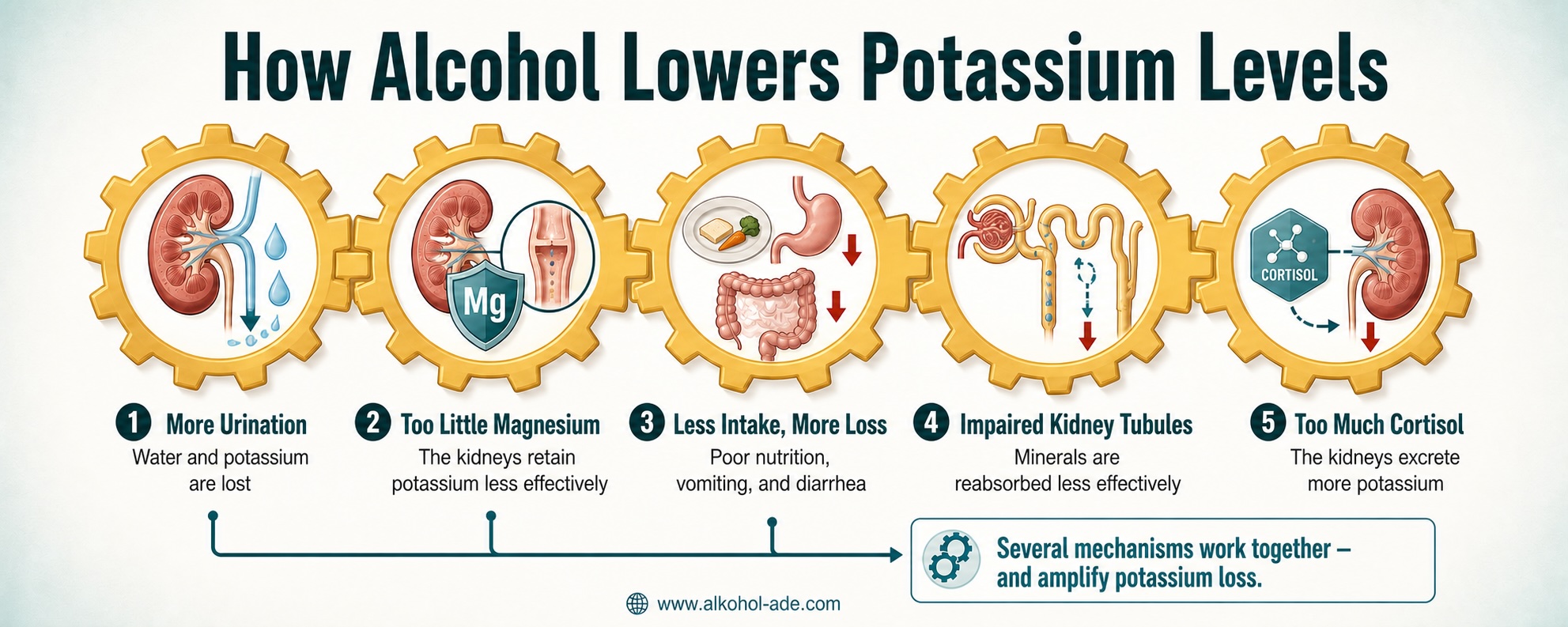
Infographic “How Alcohol Drives Down Potassium Levels”: Five interlocking gears illustrate the key mechanisms.
• Alcohol increases urine output,
• magnesium deficiency makes it harder for the kidneys to retain potassium,
• poor nutrition plus vomiting and diarrhea cause additional losses,
• damaged kidney tubules recover minerals less efficiently, and
• excess cortisol increases potassium excretion.
The mechanisms reinforce each other.
Pathway 4: Alcohol Damages the Kidney’s Filtration System
A study published in the New England Journal of Medicine showed in 61 patients: alcohol damages the delicate tubules in the kidneys that the body uses to reabsorb minerals. And that doesn’t just affect potassium — it also hits magnesium, calcium, and phosphate. The good news: after four weeks of abstinence, those tubules had largely recovered. The damage is reversible — if you stop.
Pathway 5: Alcohol Disrupts the Stress Hormone Cortisol
A lesser-known effect: chronic alcohol use can cause the body to produce too much cortisol on a sustained basis. And excess cortisol, among other things, drives the kidneys to excrete more potassium. The insidious part: this state doesn’t resolve until alcohol intake is drastically reduced or stopped entirely.
Heart Palpitations After a Weekend Binge: Holiday Heart Syndrome
In the late 1970s, American cardiologist Philip Ettinger noticed a striking pattern: patients were showing up in the ER after a weekend of heavy drinking — with racing hearts and irregular heartbeats. Atrial fibrillation, right in the middle of life, in people with no known heart disease. Ettinger called it Holiday Heart Syndrome, because it clustered around holidays and weekends.
A major factor: the loss of potassium and magnesium caused by alcohol. Both minerals are essential for the electrical stability of the cardiac muscle. When they’re missing, the heart becomes vulnerable to misfires, and the rhythm breaks down. Holiday Heart Syndrome doesn’t just hit heavy drinkers. A single weekend of hard partying can be enough.

Infographic “ER Instead of Beach Party”: On the left, a group of young adults is partying at the beach. On the right, one of them is lying in an emergency room with cardiac symptoms. Monitoring electrodes are attached to his bare chest.
The monitor shows an irregular heartbeat indicating atrial fibrillation. Icons illustrate low potassium and magnesium levels. The graphic explains that even a single intense drinking weekend can trigger Holiday Heart.
If you’ve ever experienced it — that strange heart flutter or racing pulse the day after drinking — you know the effect firsthand. The cause isn’t just in your head. It’s in your electrolyte balance.
Why Potassium Can Rise During Withdrawal
Now it gets paradoxical: the same person who just had too little potassium can have too much just days later. This happens during alcohol withdrawal. Here’s what’s going on:
As long as someone is drinking, the kidneys are working overtime, flushing out water and potassium. Once the alcohol stops, the pendulum swings back. The body switches into conservation mode, suddenly retains water, and the fluid shifts throw potassium levels off in the other direction.
Things get especially tricky in people with pre-existing liver damage. A large American cohort study of nearly 1.5 million patients showed that liver disease is an independent risk factor for recurrent hyperkalemia — meaning chronically elevated potassium levels. The reason: the damaged liver can’t absorb potassium as effectively, and if kidney function is also impaired, potassium backs up in the blood.
That’s why doctors draw blood regularly during withdrawal and monitor electrolytes. Checking once isn’t enough. The numbers can flip in the other direction within days.
Potassium as a Warning Sign: Low Levels, Higher Risk for Delirium Tremens
One research finding deserves special attention. A German study examined 827 patients admitted to an ICU for alcohol detox. The researchers wanted to know: can you predict from the bloodwork at admission who will develop delirium tremens? And indeed: for every one milliequivalent per liter decrease in potassium at admission, the statistical risk of developing DT roughly tripled. Potassium turned out to be one of the most telling warning markers of all.
A Serbian study sharpened the picture further: patients who died of delirium tremens during alcohol withdrawal frequently had lower potassium levels — even when those levels were still officially classified as “normal.” That raises a question that hasn’t been definitively answered: was it because the cutoff values for “normal” are too generous? Or because other minerals were simultaneously depleted — magnesium above all — that are needed to keep the potassium balance stable in the first place?

This shifts the perspective. Potassium isn’t just a mineral that alcohol happens to drag along on its way out. It’s a lab value that signals how dangerous a withdrawal can become. One more reason never to attempt alcohol withdrawal without medical supervision.
Why Potassium Isn’t a Mineral You Can Just Top Off on Your Own
With magnesium or vitamin B1, the general advice is often: replenish generously. With potassium, it’s different. Potassium has an extremely narrow corridor between “too little” and “too much.” Both directions are dangerous. The cardiac muscle responds to both with arrhythmias — and in the worst case, with cardiac arrest.
Caution is especially warranted in people who’ve been drinking heavily. A damaged liver or impaired kidney function can mean the body can’t process incoming potassium fast enough. What would be harmless in a healthy person can trigger a dangerously high potassium spike in someone with alcohol-related organ damage. That’s why the FDA caps over-the-counter potassium supplements at just 99 milligrams per dose — a fraction of the daily requirement. Regulations vary by country, but the underlying reason is the same: potassium in higher doses requires medical oversight.
And if you ask for a potassium supplement at the pharmacy and the pharmacist gives you a horrified look, as if you’re planning to hurt yourself: yes, potassium chloride is used in some states as part of the lethal injection protocol. That’s true. But the comparison is wildly misleading. In an execution, a massive dose of potassium is injected directly into a vein — stopping the heart within seconds.
A potassium tablet from the pharmacy has about as much in common with that as a potato peeler has with a sword. The danger lies in the dose and the route of administration, not in the substance itself. Potassium is in every banana, every potato, every glass of orange juice. The pharmacist means well, but the reaction overshoots the mark.
What does remain true: potassium at higher doses needs to be closely monitored by a doctor, because the body — especially with an alcohol-damaged liver or kidneys — can’t simply buffer the excess.
What You Can Do
If you cut back on alcohol or quit entirely, your potassium balance typically normalizes on its own. The kidney tubules damaged by alcohol regenerate within a few weeks. The magnesium deficiency that drives potassium loss can be corrected with magnesium supplements — and that’s far more straightforward than supplementing potassium directly.
A potassium-rich diet helps too: potatoes, bananas, spinach, legumes, avocados. These aren’t secret tips, but they’re effective. If you’re getting off alcohol, it’s worth paying conscious attention to your nutrition. Not because it’s a nice bonus, but because your body in this phase depends on every nutrient it can get.
The most important thing: if you’re planning a detox, get your electrolytes checked first. Potassium, magnesium, calcium, sodium. It’s a simple blood test your primary care doctor can run. And it can make a real difference — for your safety and the course of your recovery.
Frequently Asked Questions About Alcohol and Potassium
Why does alcohol cause potassium deficiency?
Alcohol lowers potassium levels through multiple pathways at once: it increases water excretion through the kidneys and flushes potassium out along with it. It frequently causes magnesium deficiency, which prevents the kidneys from retaining potassium. On top of that, poor nutrition, vomiting, and diarrhea contribute to further losses. Alcohol can also directly damage the delicate kidney tubules responsible for reabsorbing minerals.
Can alcohol cause potassium levels to go too high?
Yes, especially during alcohol withdrawal. As kidney function normalizes and the body starts retaining water, a shift can occur that causes potassium to build up in the blood. People with pre-existing liver damage or impaired kidney function are at particular risk. That’s why regular blood work during withdrawal is so important.
Can I just take a potassium supplement if my levels are low?
That’s strongly discouraged without medical supervision. Potassium has an extremely narrow corridor between “too little” and “too much” — both directions are dangerous. In someone with alcohol-damaged liver or kidneys, uncontrolled potassium supplementation can trigger life-threatening cardiac arrhythmias. Targeted potassium replacement belongs in a doctor’s hands, guided by current blood work.
What does magnesium have to do with potassium levels?
More than most people realize. Magnesium blocks a potassium channel in the kidneys called ROMK. When magnesium is missing, that channel stays open and potassium is excreted uncontrollably. In practical terms: as long as a magnesium deficiency exists, a potassium deficiency can’t be corrected — no matter how much potassium you take. Magnesium needs to be replenished first.
What is Holiday Heart Syndrome?
A condition in which cardiac arrhythmias — usually atrial fibrillation — develop after a drinking binge. The name comes from the fact that doctors observed it clustering around holidays and weekends. A key factor is the loss of potassium and magnesium caused by alcohol, which compromises the electrical stability of the cardiac muscle. Holiday Heart Syndrome can affect people who only drink heavily on occasion.
Why is a low potassium level especially dangerous during alcohol withdrawal?
Studies have shown that a low potassium level at admission to a detox facility significantly increases the risk of delirium tremens. An adequate potassium level is therefore one of the lab values doctors pay especially close attention to before and during withdrawal. This underscores why alcohol detox should always be medically supervised.
Does alcohol permanently damage the kidneys?
Not necessarily. Research has shown that the kidney tubule damage caused by chronic alcohol use is at least partially reversible. In a study of 61 patients with alcohol use disorder, kidney tubule function improved significantly after several weeks of abstinence. However, the longer and heavier the drinking, the greater the risk of lasting damage — another reason to seek medical support early.
References
- Palmer BF, Clegg DJ (2017): “Electrolyte Disturbances in Patients with Chronic Alcohol-Use Disorder.” New England Journal of Medicine, 377(14): 1368–1377. Comprehensive review of all electrolyte disturbances in chronic alcohol use.
- De Marchi S, Cecchin E, Basile A, Bertotti A, Nardini R, Bartoli E (1993): “Renal Tubular Dysfunction in Chronic Alcohol Abuse – Effects of Abstinence.” New England Journal of Medicine, 329(26): 1927–1934. The study referenced in this article on reversible kidney tubule damage from alcohol (n=61).
- Elisaf M, Liberopoulos E, Bairaktari E, Siamopoulos K (2002): “Hypokalaemia in Alcoholic Patients.” Drug and Alcohol Review, 21(1): 73–76. The Greek study cited in this article on the prevalence and causes of potassium deficiency in alcohol patients (n=127).
- Huang CL, Kuo E (2007): “Mechanism of Hypokalemia in Magnesium Deficiency.” Journal of the American Society of Nephrology, 18(10): 2649–2652. Foundational paper on the ROMK channel mechanism: why magnesium deficiency amplifies potassium loss through the kidneys.
- Eyer F, Schuster T, Felgenhauer N et al. (2011): “Risk Assessment of Moderate to Severe Alcohol Withdrawal – Predictors for Seizures and Delirium Tremens in the Course of Withdrawal.” Alcohol and Alcoholism, 46(4): 427–433. The German study referenced in this article that identified low potassium as a warning marker for delirium tremens (n=827).
- Ignjatovic-Ristic D, Rancic N, Novokmet S, Jankovic S, Stefanovic S (2013): “Risk Factors for Lethal Outcome in Patients with Delirium Tremens – Psychiatrist’s Perspective: A Nested Case-Control Study.” Annals of General Psychiatry, 12: 39. The Serbian study referenced in this article on the association between potassium levels and mortality in delirium tremens (n=190).
- Ahdoot RS, Hsiung J-T, Agiro A, Brahmbhatt YG, Cooper K, Fawaz S, Westfall L, Kalantar-Zadeh K, Streja E (2023): “Liver Disease Is a Risk Factor for Recurrent Hyperkalemia: A Retrospective Cohort Study.” Journal of Clinical Medicine, 12(14): 4562. Large VA cohort study (n=1,493,539) identifying liver disease as an independent risk factor for recurrent hyperkalemia.
- Kurajoh M, Ohsugi K, Kakutani-Hatayama M, Shoji T, Koyama H (2018): “Hypokalemia Associated with Pseudo-Cushing’s Syndrome and Magnesium Deficiency Induced by Chronic Alcohol Abuse.” CEN Case Reports, 7: 148–152. Case report on the interplay between alcohol-induced pseudo-Cushing’s syndrome and magnesium deficiency as a cause of severe hypokalemia.
- Ettinger PO, Wu CF, De La Cruz C, Weisse AB, Ahmed SS, Regan TJ (1978): “Arrhythmias and the ‘Holiday Heart’: Alcohol-Associated Cardiac Rhythm Disorders.” American Heart Journal, 95(5): 555–562. The original paper on Holiday Heart Syndrome (n=24).
Editorial content reviewed by Bernd Guzek, MD
The content on this site does not replace professional medical advice.