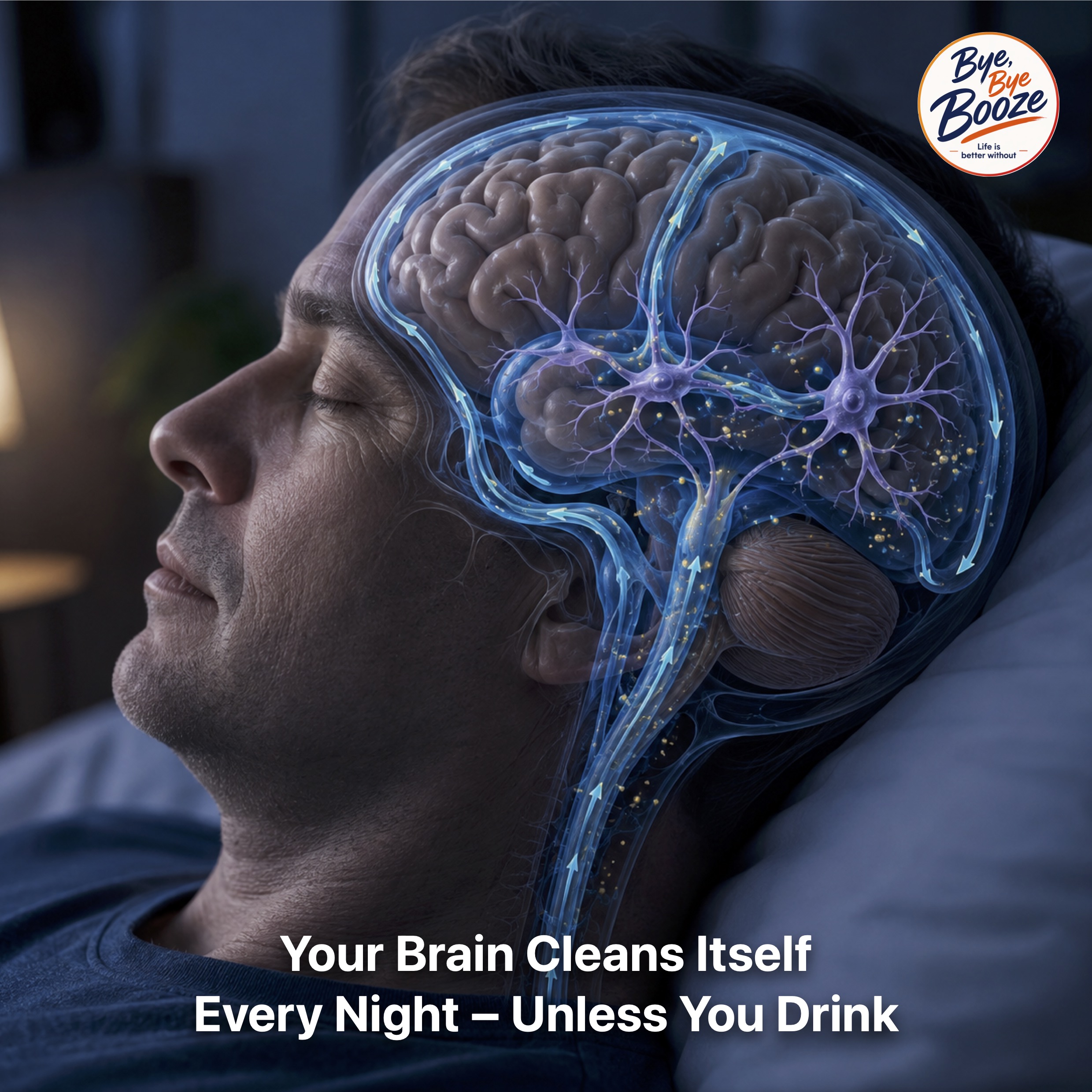
The glymphatic system is your brain’s nightly garbage truck – and alcohol shuts it down twice over. How this waste-clearance mechanism, discovered only in 2012, actually works, why it kicks into high gear during deep sleep, and what happens in sobriety: a look at the research that explains why so much gets worse after you quit – before it gets better.

Your brain cleans itself. Every night, during deep sleep. It flushes out waste products that accumulated during the day – including protein fragments that, in a worst-case scenario, can trigger Alzheimer’s disease. This cleanup system is called the glymphatic system, and most people have never heard of it. No surprise: it was only discovered in 2012.
For people who drink heavily, this matters more than most realize. Because alcohol sabotages the brain’s cleaning process in two ways at once – directly, and by destroying deep sleep.
A Cleaning System Hardly Anyone Knows About
The rest of the body has a lymphatic system that removes waste products from tissue. The lymph nodes in the neck, under the arms, in the groin – everyone has felt them at some point, at the very least during a cold or an infection. But the brain has no such system. For centuries, nobody understood how the brain gets rid of its own waste.
The answer came in 2012 from a research group at the University of Rochester. They described a previously unknown mechanism: cerebrospinal fluid flows along blood vessels into the brain tissue, mixes with interstitial fluid, and flushes out metabolic waste in the process. This is made possible by astrocytes, a group of support cells in the brain. They wrap their extensions around blood vessels. On these extensions sit specialized water channels – called aquaporin-4 channels. Without these channels, cerebrospinal fluid cannot flow efficiently. The cleaning process stalls.
The system was named “glymphatic” – a blend of “glia” (the support cells) and “lymphatic.” Among the waste products it flushes out are beta-amyloid proteins. When these proteins accumulate in the brain, they form plaques. And those plaques are strongly suspected of contributing to Alzheimer’s disease.
Why the Brain’s Cleaning System Only Works During Deep Sleep
The glymphatic system doesn’t run around the clock. It operates primarily during deep sleep. A widely cited study from 2013 showed why: during sleep, the interstitial space in the brain expands by roughly 60 percent. This allows cerebrospinal fluid to flow through the tissue far more easily. The clearance rate for beta-amyloid doubles compared to waking hours. Think of it like a dishwasher that runs overnight – by morning, the brain is clean.
In early 2025, a study in the journal Cell identified the driving mechanism behind this rinse cycle: during deep sleep, the locus coeruleus – a small brainstem nucleus – sends out norepinephrine waves roughly every 50 seconds. These waves cause the blood vessels to contract rhythmically. The contractions create a pumping action that pushes cerebrospinal fluid into the tissue and flushes waste out. Without these norepinephrine waves, the pump doesn’t run.
This explains why sleep disorders are far more than a comfort problem. Poor sleep means poorer brain cleaning. And that has measurable consequences: brain fog, concentration problems, persistent fatigue – all symptoms that people in withdrawal know all too well.
The same Cell study produced another unsettling finding: the sleep medication zolpidem – sold in the U.S. as Ambien, one of the most commonly prescribed sleeping pills – suppressed the norepinephrine waves in mice by half and reduced glymphatic flow by roughly 30 percent. Medication-induced sleep is not the same as restorative sleep. If you sleep on Ambien, you lie down – but the dishwasher never starts. The brain stays dirty.
How Alcohol Sabotages the Brain’s Cleaning System
Alcohol attacks the glymphatic system on two fronts. And both hit at the same time.
The direct damage: Even a single episode of heavy drinking measurably slows glymphatic cleaning. Cerebrospinal fluid flows in more slowly, and the removal of waste products decreases. With a one-time binge, this effect is reversible. With regular, heavy use, it’s a different story: the astrocytes become inflamed, and the aquaporin-4 water channels lose their correct position along the vessel walls. They drift away from where they belong. Researchers call this the loss of AQP4 polarization. Without properly positioned water channels, fluid exchange no longer works correctly. An animal study from 2020 showed that this damage can become irreversible with chronic use.
The indirect damage via sleep: Alcohol is one of the most effective destroyers of deep sleep in existence. Yes, it does help you fall asleep faster – that part is true. But it massively suppresses deep-sleep phases during the second half of the night. And those are precisely the phases when glymphatic cleaning runs at full capacity. If you drink in the evening and wake up around 3 a.m. – the typical pattern – you’re lying awake during the exact window when your brain should be cleaning house.
That’s the double hit: alcohol sabotages the pump directly and simultaneously shuts off the motor. The cleaning cycle fails. Night after night. It’s part of the neuroadaptation process through which the brain adjusts to the constant presence of alcohol.
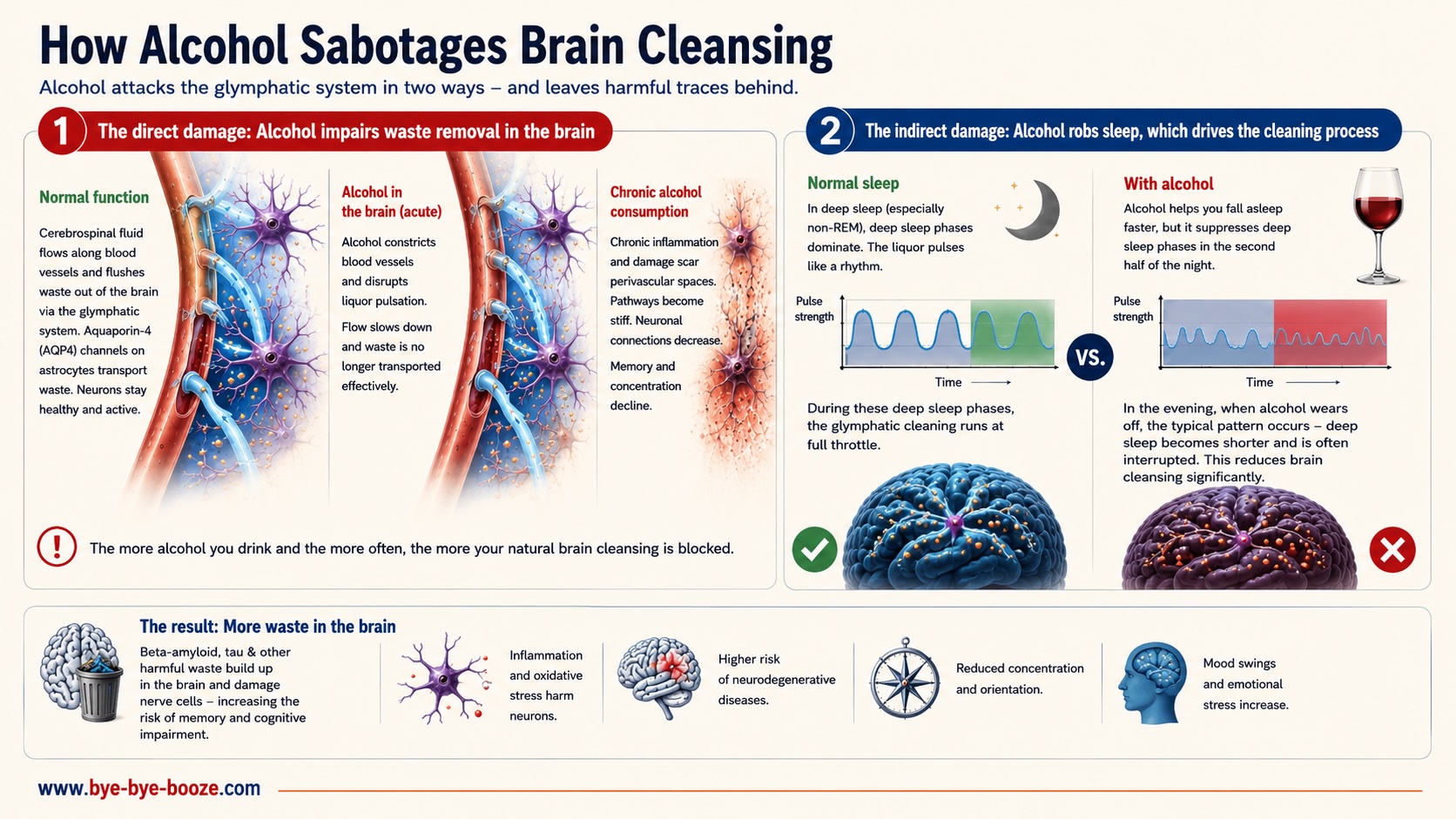
The infographic shows how alcohol impairs the brain’s nightly “garbage collection” – the glymphatic system – through two simultaneous pathways.
Direct effect: Normally, cerebrospinal fluid flows along blood vessels through the brain tissue and carries metabolic waste away. Astrocytes and their aquaporin-4 water channels (AQP4) play a critical role in this process. Even a single episode of heavy drinking can temporarily reduce fluid flow and waste removal. With regular heavy alcohol use, astrocytes can become inflamed and AQP4 channels can lose their correct alignment along the blood vessels. As a result, glymphatic cleaning becomes less effective.
Indirect effect via sleep: The glymphatic system is particularly active during deep sleep. Alcohol may make it easier to fall asleep, but it disrupts sleep architecture and especially the restorative phases of sleep later in the night. This robs the brain of a crucial window for its nightly cleaning.
Potential consequence: Metabolic waste products such as beta-amyloid may not be cleared as effectively. Chronically impaired glymphatic function has been linked to inflammatory processes, cognitive impairment, and an increased risk of neurodegenerative diseases.
For the sake of completeness: a widely discussed study from 2018 found that very low doses of alcohol actually improved glymphatic function in mice – a so-called J-shaped dose-response effect. At first glance, that sounds like good news for the after-work beer. It isn’t. The study was done in mice, the dose was equivalent to less than half a glass of wine, and for people with a problematic drinking pattern, “just a little” is not a realistic option. It’s like telling a diabetic that a teaspoon of sugar is healthy.
From a Clogged Cleanup System to Dementia
When glymphatic cleaning doesn’t work properly for years, beta-amyloid accumulates in the brain. Normally, this protein is cleared during sleep. When that doesn’t happen, deposits form – the very plaques considered the prime suspects behind Alzheimer’s disease.
Epidemiologically, the link between heavy chronic alcohol use and dementia is well established. Impaired glymphatic clearance provides a plausible mechanism for that connection. An important caveat: in humans, causal proof via the glymphatic pathway has not yet been established. But the animal data is so consistent that this link is being actively investigated.
This is not a reason to panic. It is a reason to take your sleep seriously – and to see alcohol for what it is as far as the brain is concerned: not a relaxation aid, but a saboteur.
What Happens in Sobriety – Worse Before It Gets Better
People who quit drinking often experience the exact opposite of what they expected at first: energy crashes, intensified fatigue, brain fog, and listlessness. It feels like sobriety is making everything worse. Many ask themselves: was alcohol the only thing keeping me going?
From the perspective of the glymphatic system, the initial worsening makes sense. The brain has accumulated a backlog of waste products over months or years. Once the alcohol is gone and sleep architecture slowly begins to recover, the glymphatic system starts working through that backlog. This takes energy and time. Brain fog and fatigue in the first few weeks are not a sign of failure – they’re a sign that the cleaning is starting up again. These symptoms are often part of withdrawal symptoms and Post-Acute Withdrawal Syndrome (PAWS).
For many people, the situation improves significantly with continued abstinence. The brain’s neuroplasticity enables a gradual recovery. Deep sleep improves, the water channels can partially realign, and glymphatic clearance increases again. How fast and how completely this happens depends on how long and how much someone drank.
With very long-term, heavy use, some damage may be permanent. Still: for most people, cognitive function, sleep quality, and overall well-being improve noticeably in sobriety.
What You Can Do for Your Glymphatic System
Since the glymphatic system is primarily active during deep sleep, anything that promotes deep sleep is also an investment in brain cleaning.
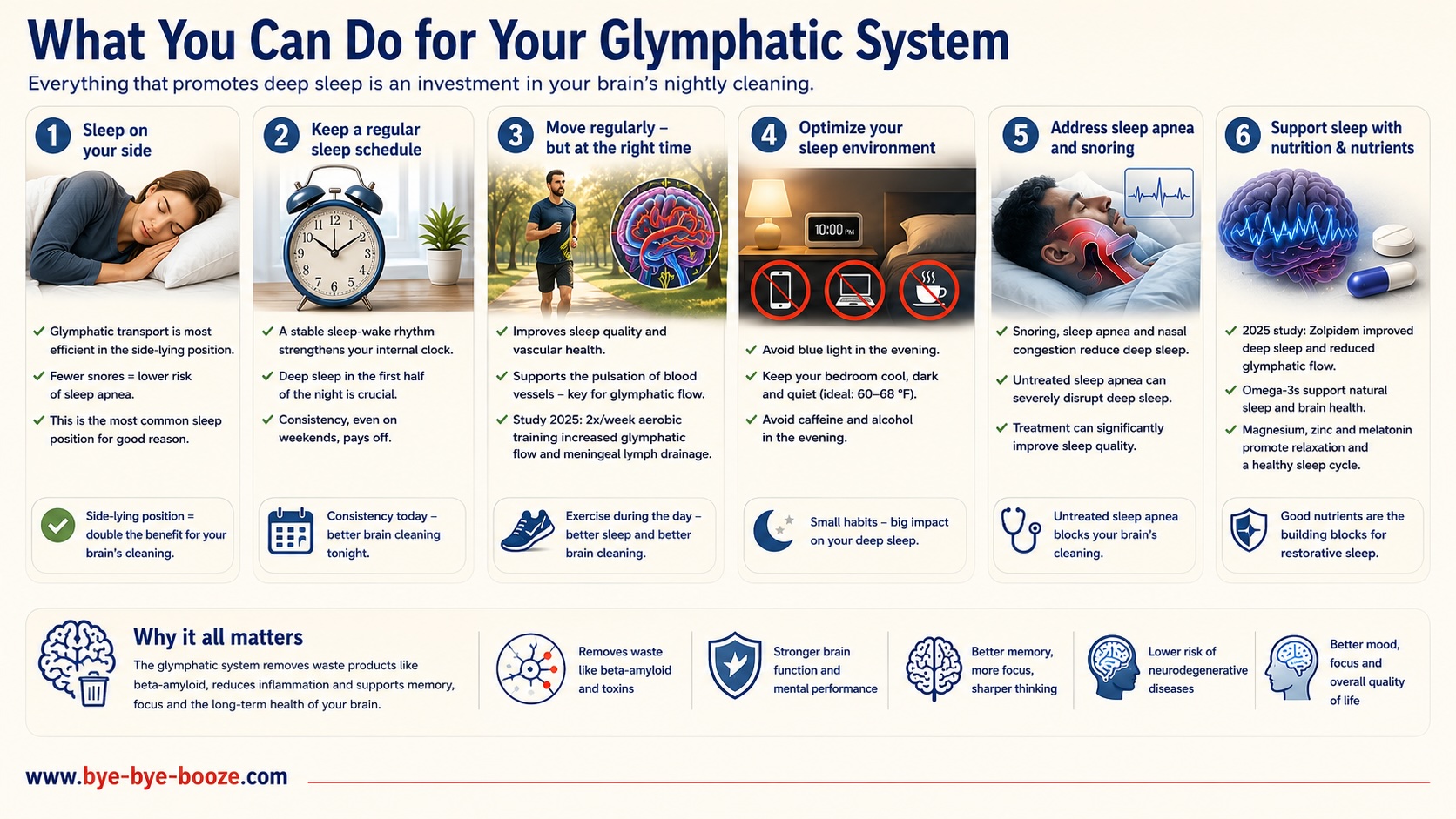
The infographic shows six ways to support the glymphatic system and the brain’s nightly cleaning process. The key factor is good, uninterrupted deep sleep.
1. Sleep on your side: Research suggests that glymphatic transport may be most efficient in the lateral (side) position. Side sleeping can also reduce snoring, which in some people may decrease sleep-related breathing problems.
2. Keep a regular sleep schedule: A stable sleep-wake rhythm supports the circadian cycle and reliable melatonin release. Regularity makes it easier for the brain to enter the sleep stages that are critical for cleaning.
3. Exercise regularly: Physical activity improves sleep quality and vascular health. Both can support glymphatic function. Early human studies suggest that aerobic exercise may also improve glymphatic fluid inflow and meningeal lymphatic drainage.
4. Practice good sleep hygiene: Less screen light in the evening, a cool, dark, and quiet bedroom, and avoiding late-day caffeine can promote restorative sleep and sufficient deep-sleep phases.
5. Get checked for sleep apnea: Heavy snoring, witnessed breathing pauses, or pronounced daytime sleepiness may be signs of sleep apnea. The repeated sleep interruptions impair deep sleep and, by extension, the brain’s nightly cleaning. A medical evaluation or a sleep study may be warranted.
6. Be cautious with sleep medications: Drug-induced sleep does not necessarily equal natural deep sleep. Animal data shows, for example, that zolpidem can impair norepinephrine waves that are important for glymphatic flow. Sleep medications should only be taken in consultation with a doctor and never discontinued on your own.
Key takeaway: Regular and preferably natural deep sleep, exercise, and good vascular health create favorable conditions for the glymphatic system to clear metabolic waste from the brain.
Sleep on your side. A 2015 study from Stony Brook University showed that glymphatic transport is most efficient in the lateral position – significantly better than lying on your back or stomach. The researchers confirmed this using both MRI imaging and fluorescent tracers. The fact that side sleeping is the most common position among humans and mammals may be an evolutionary adaptation to exactly this. And there’s a practical bonus: back sleepers snore more. Snoring is a risk factor for sleep apnea. Sleep apnea massively disrupts deep sleep and significantly impairs the glymphatic system. If you already sleep on your side, you’re doing double duty for your brain’s cleaning.
Keep a regular sleep schedule. A stable sleep rhythm stabilizes the circadian cycle and the switch between waking and sleeping phases. The sleep hormone melatonin is released more reliably as a result. Going to bed at a different time every night makes it unnecessarily hard for your brain to switch into cleaning mode.
Exercise. Regular physical activity has been shown to improve both sleep quality and vascular health. Since the glymphatic system depends on functioning blood vessels and their pulsation, exercise supports the cleaning process directly. A 2025 study – one of the first in humans – showed that just twelve weeks of aerobic training measurably increased glymphatic inflow and meningeal lymphatic drainage.
Sleep hygiene. Screen light in the evening, an overly warm bedroom, and late-day caffeine reduce the proportion of deep sleep. It sounds basic, but it makes a measurable difference.
Get checked for sleep apnea. For persistent sleep problems, a sleep study may be worthwhile, especially if symptoms of sleep apnea are present – snoring, breathing pauses, daytime sleepiness despite adequate hours of sleep. Sleep apnea disrupts deep sleep so severely that glymphatic cleaning can barely take place.
Be cautious with sleep medications. The 2025 Cell study mentioned earlier showed that zolpidem (Ambien) suppressed the norepinephrine waves during deep sleep by half and significantly reduced glymphatic flow. Those were animal data – but the message is clear: sleep under sedatives is not the same as natural deep sleep. If you take sleep medication, do so only in consultation with your doctor and don’t stop on your own. But it’s worth having the conversation.
Do you have questions about this topic? Ask us here!
Frequently Asked Questions About the Glymphatic System (FAQ)
What is the glymphatic system?
The glymphatic system is the brain’s cleaning system. It uses cerebrospinal fluid to flush metabolic waste from brain tissue – including beta-amyloid proteins linked to Alzheimer’s disease. This process runs primarily during deep sleep and was first described scientifically in 2012.
Why does alcohol damage the glymphatic system?
Alcohol attacks the brain’s cleaning system on two fronts: it directly damages the water channels on the brain’s support cells that are responsible for fluid transport. At the same time, it destroys deep sleep – the exact phase when cleaning is most active. With chronic use, this damage can become irreversible.
Does the glymphatic system recover in sobriety?
Yes, for many people the function improves after quitting. Sleep quality recovers step by step, and with it, the brain’s nightly cleaning. The initial fatigue and brain fog in the first weeks are actually a sign that the cleaning is restarting. With very long-term, heavy use, however, some damage may be permanent.
Which sleeping position is best for the brain's cleaning system?
A 2015 study showed that glymphatic transport is most efficient in the side-lying position. Side sleeping is also the most common position among humans and mammals. An additional benefit: side sleepers snore less, which reduces the risk of sleep apnea – and therefore the risk of impaired brain cleaning.
Can sleeping pills interfere with the brain's cleaning system?
Yes. A study published in the journal Cell in 2025 showed that zolpidem (Ambien) suppressed the norepinephrine waves critical to brain cleaning during deep sleep by half, and reduced glymphatic flow by roughly 30 percent. Medication-induced sleep is not the same as natural restorative sleep. If you take sleep medication, discuss it with your doctor.
References
- Iliff JJ, Wang M, Liao Y et al. (2012): “A Paravascular Pathway Facilitates CSF Flow Through the Brain Parenchyma and the Clearance of Interstitial Solutes, Including Amyloid β.” Science Translational Medicine, 4(147):147ra111.
- Xie L, Kang H, Xu Q et al. (2013): “Sleep Drives Metabolite Clearance from the Adult Brain.” Science, 342(6156):373–377.
- Lee H, Xie L, Yu M et al. (2015): “The Effect of Body Posture on Brain Glymphatic Transport.” Journal of Neuroscience, 35(31):11034–11044.
- Lundgaard I, Wang W, Eberhardt A et al. (2018): “Beneficial Effects of Low Alcohol Exposure, but Adverse Effects of High Alcohol Intake on Glymphatic Function.” Scientific Reports, 8:2246.
- Liu Q, Yan L, Huang M et al. (2020): “Experimental Alcoholism Primes Structural and Functional Impairment of the Glymphatic Pathway.” Brain, Behavior, and Immunity, 85:106–119.
- Hauglund NL, Andersen M, Tokarska K et al. (2025): “Norepinephrine-mediated Slow Vasomotion Drives Glymphatic Clearance During Sleep.” Cell, 188(3):606–622.
- Yoo RE, Kim JH, Moon HY et al. (2025): “Long-term Physical Exercise Facilitates Putative Glymphatic and Meningeal Lymphatic Vessel Flow in Humans.” Nature Communications, 16:3360.
- Lin JY, Zhang HB, Luo L, Li RJ, Wang XG (2025): “Glymphatic System Dysfunction in Alcohol Use Disorder: Current Understanding and Future Directions.” World Journal of Psychiatry, 15(10):107936.
Editorial content reviewed by Bernd Guzek, MD
The content on this site does not replace professional medical advice.