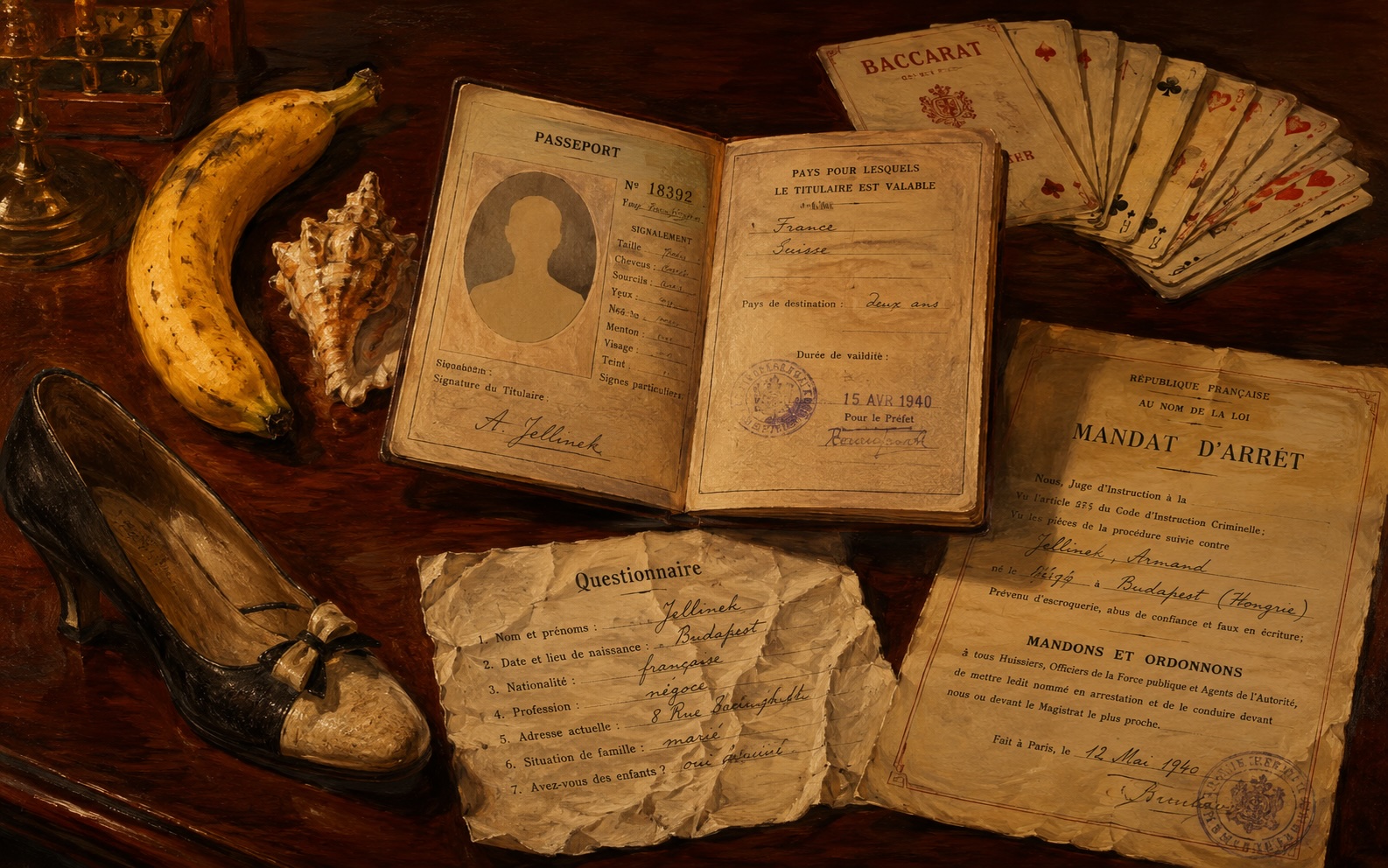
In the first part of our Jellinek series, we examined the data foundation of the model that shaped addiction treatment for half a century: 98 hand-picked questionnaires, no women, no control group. In the second part, we looked at how Jellinek cut the female half of humanity from his research – and the price addiction medicine is still paying for it today. Today, we take a closer look at the man himself.

Now it gets personal. Because the biography of the man who created the most influential model in addiction medicine is at least as adventurous as his scientific methodology. To put it charitably.
The following is based on the meticulous archival research by Judit Hajnal Ward at the Rutgers Center of Alcohol Studies, who was the first to scientifically document Jellinek’s Hungarian years.
Shoes, Languages, and a Talk Before Freud
Elvin Morton Jellinek – nickname “Bunky” – was born in 1890 in New York. His mother Rose Jacobson was a celebrated soprano who performed under the stage name Marcella Lindh. Shortly after Morton’s birth, the family moved to Budapest, where his father took over the family business. Jellinek grew up in the intellectual hothouse of the Austro-Hungarian Empire – his contemporaries in Budapest included Béla Bartók, Georg Lukács, Sándor Ferenczi, and Leo Szilárd.
Starting in 1908, Jellinek studied at the universities of Berlin, Grenoble, and Leipzig – linguistics, ethnology, religious studies, philosophy. He was reportedly fluent in nine languages and able to communicate in four more. In 1912, he published his first book reviews in an ethnological journal. His first book appeared in 1917, in Hungarian: “A saru eredete” – a treatise on the origin of shoes, actually an ethnological study on the symbolic role of footwear in cults, folk customs, and religions around the world.
In 1918, Jellinek appeared as a speaker at the 5th International Psychoanalytic Congress in Budapest – the same congress where Sigmund Freud delivered the keynote and the auditorium was so packed that, according to contemporary reports, “not even three more people could have fit inside.” Jellinek’s topic: the psychological interpretation of blood pacts and ritual contract ceremonies.
Up to this point: a Renaissance man with an impressive range. Member of the Hungarian Ethnological Society, board member of his father’s Hunnia Press, decorated with the Golden Cross of Merit for his service as an ambulance driver in World War I. What came next, however, reads less like a scientific career and more like an adventure novel. Once again, very charitably put.
Jellinek: “One of Hungary’s Four Greatest Con Men”
In 1920, Jellinek was a ministerial secretary in the office of the Hungarian Prime Minister – a government position with influence and connections. He used both for an elaborate Ponzi schemeinvolving illegal currency transactions. The post-war chaos following the collapse of the Austro-Hungarian Empire made it possible: the successor states were stamping the old crown banknotes with national markings, inflation was galloping, and anyone who could get hold of foreign currency could make a fortune.
Jellinek offered dollars at 140 crowns when the market rate was 230. He produced written guarantees from a bank director, had jewelry smuggled out of the country, and had the proceeds brought back to Budapest via diplomatic couriers – whose luggage was never inspected. His clients: banks, barons, millionaires, government officials, artists. They all knew it was illegal. They wanted the quick money anyway.
In early June 1920, Jellinek collected a large sum for further transactions – and vanished. On June 18, the Budapest newspapers exploded. The headlines over the following days: “The mysterious disappearance of Morton Jellinek, ministerial secretary.” “Where did Morton Jellinek’s diamonds go?” “Police interrogate Jellinek’s agents.” “Arrest warrant for Morton Jellinek.” “Was Jellinek insane?“
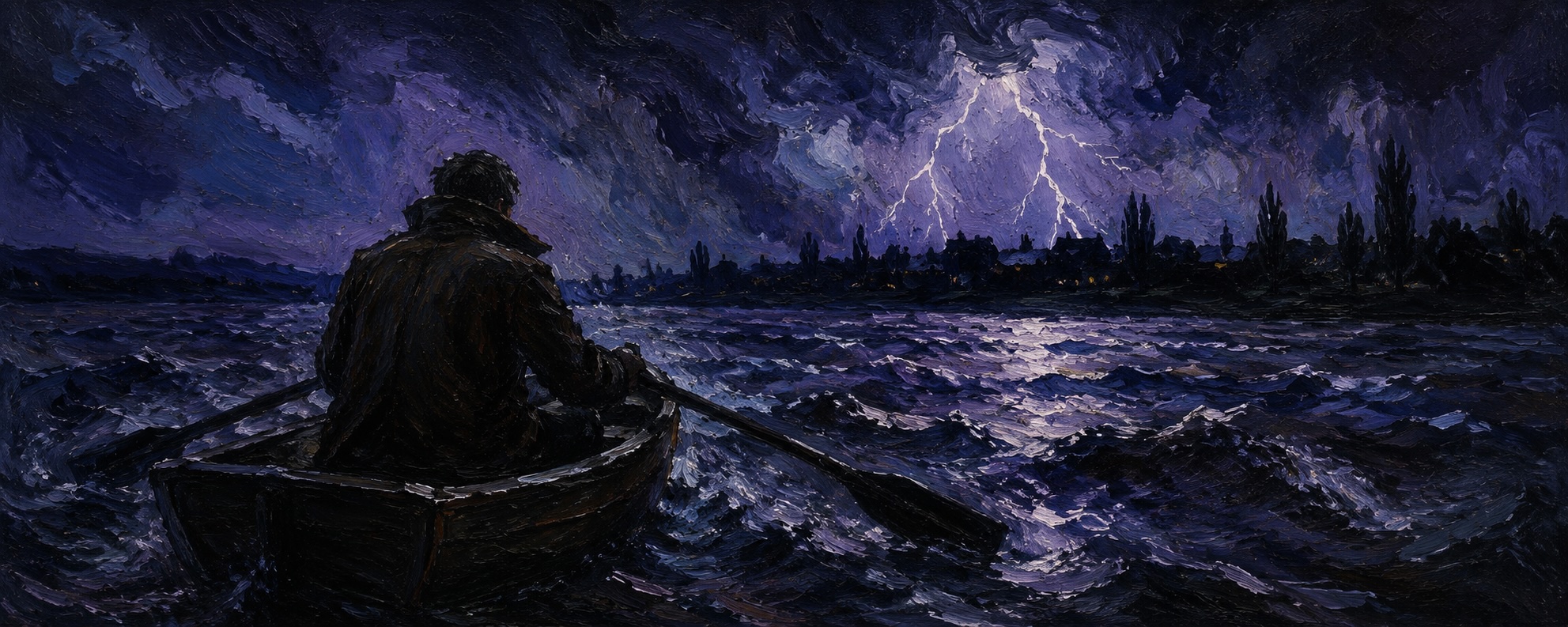
His escape was like something out of a movie. Jellinek took a train to Szeged, near the Yugoslav border. Without valid papers, he wasn’t allowed to cross the Tisza bridge. He got into a small boat anyway – even though Serbian soldiers were shooting at every boat on the river. He wore nothing but a sport coat. He left his briefcase, containing documents but no valuables, with an accomplice. It was the last time anyone in Hungary saw him.
On June 29, 1920, an arrest warrant was issued in four languages and distributed through major newspapers. The physical description: medium height, slender, blue-gray eyes, dark narrow face, black hair, clean-shaven. Speaks Hungarian, German, English, French, and Italian “quickly and nervously.” Wanted for fraud, embezzlement, and smuggling. The victims, however, refused to press charges – which Ward interprets as a tacit admission of their own complicity.
The 1957 communist propaganda book “Szélhámosok, kalandorok” (Con Men, Adventurers) devoted an entire chapter to Jellinek – as one of Hungary’s four greatest con artists. A second book carried the chapter title “Morton Jellinek Disappears with the Money.” In Hungarian biographies of his friend, the renowned anthropologist Géza Róheim, it is casually mentioned that Jellinek “later became known for his frauds.” The court files on the case (Dossier B.7069/1920) remain incomplete to this day – Ward found evidence of tampering with the register entries.
Warrant Expired – Quick Trip Back to Berlin, Buy a Villa
In a coffeehouse, Jellinek later recounted his escape – forty-five minutes on the Tisza in a thunderstorm, Serbian border guards shooting over their heads, a cursing smuggler demanding a substantial portion of the cash as payment. Then the alleged route: Romania, Yugoslavia, along the Dalmatian coast to Italy, onward to New York and Central America.
Ten years later, in 1930, the Hungarian acquaintance and journalist Laszlo Frank ran into the vanished man by chance on a Berlin street. Frank asked whether being there didn’t put him at risk of arrest. Jellinek said no: his lawyer had confirmed that the ten-year statute of limitations since the warrant had expired.
He was now a coffee farmer and continuing his ethnological studies, he said. In Berlin, he had bought his parents a villa in Grunewald. Then he asked Frank to pass on a message to their mutual acquaintances: “There is no more Morton Jellinek. He is dead.“
A year later, however, Jellinek rose from the dead at Worcester State Hospital in Massachusetts. The timing was no coincidence.
Ten Years in the Fog: Bananas Under a False Name
What happened in the ten years after the escape remains shrouded in semi-darkness to this day. Jellinek’s daughter Ruth Surry later said that her father had initially traded with locals in Sierra Leone – medicine for hides and shells – and worked as a cook in a restaurant before signing on as a biometrician with the Elder Dempster steamship line.
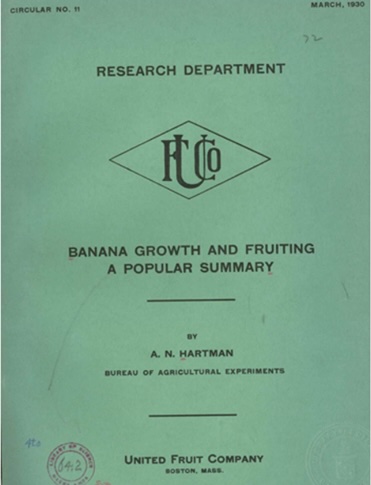
All of this under the pseudonym “Nikita Hartmann.” Starting in 1926, he resurfaced – now as “A. N. Hartman,” the Americanized version – in Honduras, where he researched banana diseases for the United Fruit Company and published at least four research reports between 1928 and 1930, including the monograph “Banana Growth and Fruiting.” When he completed the book at United Fruit’s Boston headquarters, he did so under his real name, E. M. Jellinek – which caused the company some embarrassment, since they had only known him as Hartman.
When Laszlo Frank ran into him by chance in Berlin in 1930, Jellinek said he was a coffee farmer in South America. Not a word about Honduras, bananas, or biometrics. Biographers noted: Jellinek apparently possessed a remarkable talent for covering his tracks.
Thelma Anderson, his later second wife, apparently knew more. In a 1963 letter to biographer Mark Keller, she asked that any biographical account “not begin earlier than the banana book, preferably with the Worcester years.” And added: “I would be glad to tell you the reasons privately, but I do not wish to put them in writing. Believe me, they are good reasons.”
Jellinek’s Resurrection in Massachusetts
In 1931, Jellinek materialized in the United States. He began as chief biometrician at Worcester State Hospital in Massachusetts, where he researched schizophrenia until 1938 – surrounded, as Ward noted, by a conspicuous number of Hungarian colleagues. In 1939, he was commissioned to review the scientific literature on alcohol. Starting in 1941, he headed the Yale Summer School of Alcohol Studies. The shoe historian, ethnologist, congress speaker before Freud, ministerial secretary, currency speculator, shell trader, and banana researcher had become an alcoholism expert.
In 1946 came the study that changed everything – based on those 98 questionnaires from AA members that we have already examined. In 1960, his magnum opus followed: “The Disease Concept of Alcoholism.” Jellinek died in 1963 at the desk in his study at Stanford.
Jellinek’s Academic Credentials: Fact or Fabrication?
Jellinek’s academic qualifications are a chapter in themselves. On his CV, he listed two degrees from the University of Leipzig: an “M.Ed.” (Master of Education) from 1913 and an “Sc.D.” (Doctor of Science) from 1936.
In 1996, the University of Leipzig informed biographer Ron Roizen what Jellinek had actually studied there: introduction to linguistics, German syntax, phonetics, introduction to ethnology, comparative ethnology, religious studies. Enrolled from 1911 to 1914. And – explicitly noted – no doctoral degree conferred.
The “Sc.D.” from 1936 is even less plausible: Jellinek was of Jewish origin. Three years after the Nazi seizure of power – and one year after the Nuremberg Race Laws took effect – he claimed to have received an honorary doctorate from a German university. Not exactly realistic, but virtually impossible to verify at the time.
Moreover, German universities did not award the “Sc.D.” in that form. The standard German doctoral degrees were Dr. med., Dr. phil., Dr. rer. nat., or Dr. jur. An Sc.D. is primarily an Anglo-American designation. Someone rendering a German doctoral degree as “Sc.D.” on an American CV would be conceivable – but it remains unusual.
Roizen’s assessment, at any rate, was unambiguous: Jellinek had fabricated his education and his titles.
There is, however, one verifiable honorary degree: in 1956, the University of Chile awarded Jellinek honorary membership in its medical faculty. In the certificate, his name is misspelled – as “Emil” instead of Elvin. It is the only academic title whose existence can be documented. The Rutgers archive comments on the situation diplomatically: “Jellinek’s education was more important than his formal qualifications.”
The most piquant footnote came from the anthropologist William Madsen. In the 1980s, Madsen publicly attacked the philosopher Herbert Fingarette for calling Jellinek a “biostatistician.” That was wrong, Madsen thundered, and he would certainly not reveal Jellinek’s true academic qualification – Fingarette should do his own research. Madsen was thus passionately defending an academic title that may never have existed.
Jellinek’s Many Names and Identities
Jellinek’s biography is threaded through with name changes and alter egos. His first name appears in the sources as Elvin, Erwin, and Alvin. His middle name shows up as Morton, Marton, Márton, Martin, Merton, Morty, and Mortimer. In Honduras he was A. N. Hartman, derived from the alias Nikita Hartmann. At Worcester, he named his satirical persona “Petronius” and his stomach ulcer “Habakkuk.” Ward calls this “self-imposed multiple personalities” – a man who spent his entire life crafting different identities.
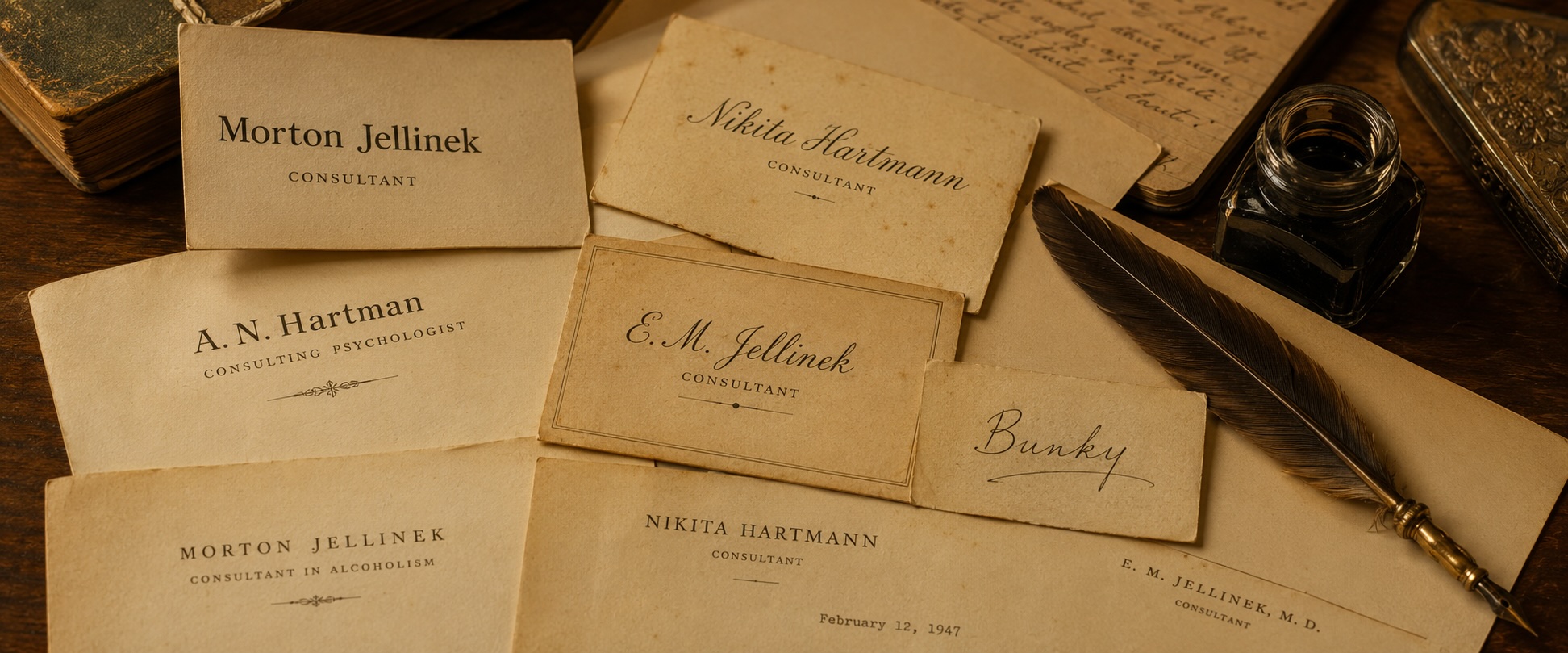
And then, of course, there was “Bunky” – the nickname he insisted on. According to oral tradition, the word supposedly means “little radish” in Hungarian. Ward, herself a native Hungarian, noted drily: the Hungarian word for radish is “retek.” A root “bunk-” with that meaning does not exist. Jellinek knew this as a native speaker – and insisted on the nickname anyway.
What actually sounds similar in Hungarian is “bunkó” – a club or cudgel, and in slang: a boor or lout. Ward’s alternative etymology: the card game bunco, a variant of baccarat. According to Budapest newspapers, baccarat was Jellinek’s great passion – he would wager 30,000 to 40,000 crowns in a single night.
Either way: the founding father of addiction medicine bore a nickname that means either “lout” or “card cheat.” And insisted on it.
Who Funded the Research?
Jellinek’s 1946 study was funded by two people: Marty Mann, the first woman to achieve long-term sobriety in Alcoholics Anonymous, and R. Brinkley Smithers, heir to the co-founder of IBM. In 1944, Mann had founded the National Committee for Education on Alcoholism – with the stated goal of establishing alcoholism as a disease in the public mind. Smithers, who himself got sober in 1954, invested over $40 million in alcoholism programs over the course of his lifetime and also funded Jellinek’s 1960 magnum opus, “The Disease Concept of Alcoholism.”
Both had a clear interest in the outcome: scientific confirmation that alcoholism is a disease requiring professional treatment. And that is exactly what Jellinek delivered – based on 98 hand-picked questionnaires, without a control group, without women, and with academic credentials that cannot be verified.
That doesn’t automatically make his findings wrong. But it explains why, for decades, nobody looked too closely at the methodology.
What Remains of Jellinek’s Model
Jellinek moved alcoholism out of the moral corner and declared it a disease. That was a hugely important contribution that no one can take away from him, and no one wants to. Alcoholics Anonymous, building on the foundation of his model, has helped millions of people get sober and stay sober. Anyone who finds support there should keep it and continue to receive it.
But a model deserves to be measured by its foundations. The foundations of the Jellinek Model are those of a man who discarded data that didn’t fit, excluded women because they disrupted his scheme, claimed academic titles that cannot be verified, and cultivated his nickname as consistently as his shifting identities. A man whose own life – with its ruptures, reinventions, and course changes – was the exact opposite of what his model claims: predictable, linear, progressing in orderly stages.
The NESARC study has shown that alcohol dependence is not a one-way street but a spectrum. Mark Willenbring has shown that the current treatment system never reaches most of those affected. And Jellinek’s biography shows that the man who set it all in motion was a brilliant, charismatic, multilingual adventurer – but not a reliable, rigorous scientist.
His second wife lovingly called him a “screwball.” The Hungarian justice system called him a fraud. Addiction medicine called him its founding father. All three were right in their own way.
Discuss this topic in our forum
Frequently Asked Questions About E. M. Jellinek’s Biography (FAQ)
Who was E. M. Jellinek, really?
Elvin Morton Jellinek (1890–1963) is considered the founder of the disease model of alcoholism and headed the Yale Summer School of Alcohol Studies starting in 1941. Before he became an addiction researcher, however, he had already led an eventful life as an ethnologist, ministerial secretary, and – under a false name – as a banana researcher. His academic titles remain unverifiable to this day.
Is it true that Jellinek was a wanted con man?
Yes. In 1920, while serving as a ministerial secretary in the office of the Hungarian Prime Minister, Jellinek was involved in an illegal currency Ponzi scheme. When the scheme collapsed, he fled across the Tisza River into Serbia. An international arrest warrant followed, and several Hungarian books list him as one of the country’s four greatest con artists.
What happened in the ten years between Jellinek's escape and his appearance in the U.S.?
Between 1920 and 1931, Jellinek’s biography is largely shrouded in darkness. What is documented is that, under the pseudonym “A. N. Hartman,” he researched banana diseases for the United Fruit Company in Honduras and published several scientific papers – before resurfacing under his real name at Worcester State Hospital in Massachusetts in 1931.
Are Jellinek's academic degrees real?
They cannot be verified. Jellinek claimed an M.Ed. (1913) and an Sc.D. (1936) from the University of Leipzig, which, according to the university’s own records, were never conferred. The alleged honorary doctorate from 1936 is particularly implausible, since Jellinek was of Jewish origin and the Nuremberg Race Laws were already in effect at the time. Biographer Ron Roizen concludes that Jellinek fabricated his qualifications.
Where does Jellinek's nickname 'Bunky' come from?
The popular explanation that “Bunky” means “little radish” in Hungarian is false – the Hungarian word for radish is “retek.” Archivist Judit Ward instead suggests a connection to “bunkó” (a boor or lout) or to the card game “bunco,” a variant of baccarat that Jellinek played passionately.
Who funded Jellinek's groundbreaking alcoholism study?
The 1946 study was funded by Marty Mann, the first woman to achieve long-term AA sobriety, and R. Brinkley Smithers, heir to the co-founder of IBM. Both had a clear interest in scientifically legitimizing alcoholism as a disease – exactly the result that Jellinek’s research delivered.
Why is Jellinek's eventful biography relevant to addiction medicine today?
Because his disease model still shapes many treatment programs today, even though its originator was not a conventional, reliable scientist but an adventurer with fabricated credentials and multiple identities. That doesn’t automatically invalidate his contribution, but it sheds light on why the methodological weaknesses of his research went largely unquestioned for so long.
References and Sources
Ward, J. H. (2014): “E. M. Jellinek: The Hungarian Connection.” In: Substance Abuse Library and Information Studies: Proceedings of the 36th Annual SALIS Conference, 42–54.
Ward, J. H., Roizen, R. & Saunders, B. (2016): “Re-Introducing Bunky at 125: E. M. Jellinek’s Life and Contributions to Alcohol Studies.” Journal of Studies on Alcohol and Drugs, 77(3), 375–383.
Ward, J. H. (2016): “A Tribute to Bunky at 125: A Comprehensive Bibliography of E. M. Jellinek’s Publications.” Journal of Studies on Alcohol and Drugs, 77(3), 371–374.
Rutgers Center of Alcohol Studies Archives: “Bunkyana – Artifacts, Images, and Documents Related to Jellinek.” Online at Rutgers
Roizen, R. (1997): “Jellinek’s Phantom Doctorate.” Online at roizen.com
Roizen, R. & Ward, J. H.: “On E. M. Jellinek’s Trail.” Points: The Blog of the Alcohol and Drugs History Society. Online at Points
Frank, L. (1957): Szélhámosok, kalandorok [Con Men, Adventurers]. Budapest: Bibliotheca.
Horváth et al. (1959): Régi jó világ: a Horthy-korszak nagy panamáiból [The Good Old Days: The Greatest Scandals of the Horthy Era]. Budapest: Kossuth Könyvkiadó.
Peele, S.: “R. Brinkley Smithers: The Financier of the Modern Alcoholism Movement.” Online at peele.net
Falcone, T. (2003): cited in Ward et al. (2016), on the funding of the Jellinek study by Marty Mann and R. Brinkley Smithers.
Jellinek, E. M. (1946): “Phases in the Drinking History of Alcoholics.” Quarterly Journal of Studies on Alcohol, 7, 1–88.
Jellinek, E. M. (1960): The Disease Concept of Alcoholism. Hillhouse Press, New Haven.
Editorial content is reviewed by Bernd Guzek, MD. The content on this website does not replace medical advice.