The kynurenine pathway is the main metabolic route for the amino acid tryptophan in your body. Along this pathway, your body makes the energy carrier NAD⁺ along with several compounds that act on your brain. Some of them calm your nerve cells down, others fire them up. Your brain needs both the calming and the stimulating compounds. What matters is the balance between them, and alcohol, stress, and inflammation can tip that balance. The research is still young, but it offers a plausible explanation for the low mood, cravings, and trouble concentrating that so many people experience after drinking and in early sobriety.
Tryptophan at the Railroad Switch #
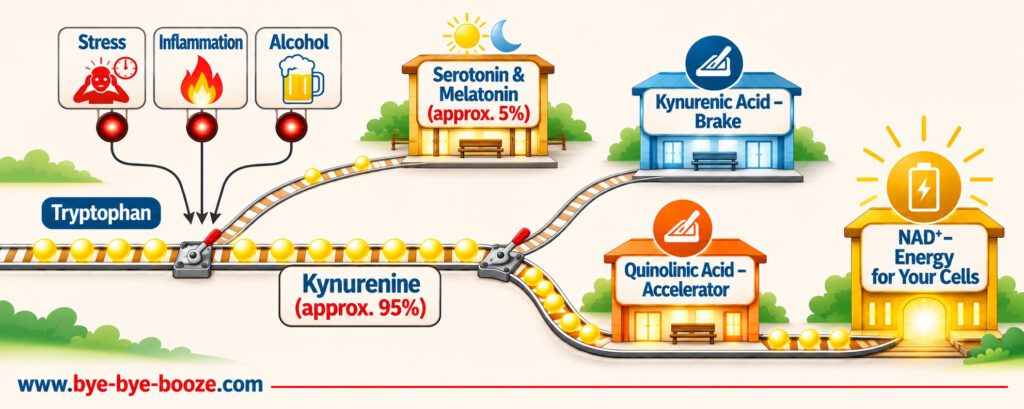
Tryptophan is one of the essential amino acids, which means your body can’t make it on its own. You have to get it from food. Most people know tryptophan as the building block for serotonin, the feel-good messenger, and for the sleep hormone melatonin. But only a small share actually ends up there. About 95 percent of your tryptophan is processed through the kynurenine pathway, where your body makes compounds it urgently needs, above all for supplying your cells with energy.
Think of it as a switch on a railroad track. One track leads to serotonin, the other to kynurenine. Two enzymes mainly decide how that switch is set. The enzyme TDO sits in your liver and gets ramped up by the stress hormone cortisol, among other things. The enzyme IDO sits in immune cells and in the brain and is switched on by inflammatory signals. The more stress and inflammation you have, the more tryptophan flows toward kynurenine and the less is left over for serotonin.
Brake and Gas Pedal: What Kynurenine Turns Into #
Kynurenine itself is just an intermediate step. It travels from your bloodstream into your brain, where it hits a second switch. Which way it goes depends on which cells pick it up.
In certain support cells of the brain called astrocytes, kynurenine is mostly turned into kynurenic acid. It works like a brake. Kynurenic acid dampens the NMDA receptors, the docking sites through which the excitatory messenger glutamate does its job. That makes it calming overall, and it protects nerve cells from overstimulation.
In the brain’s immune cells, the microglia, kynurenine is more likely to become quinolinic acid. It works like a gas pedal and stimulates the NMDA receptors. Quinolinic acid is not a toxin in itself. It is the direct precursor of NAD⁺, and your body needs it in normal amounts. Only in excess does it overstimulate nerve cells, drive oxidative stress, and potentially damage them. The more your microglia are activated by inflammation, the further the balance tips in this direction.
At the end of the kynurenine pathway sits a molecule every cell in your body needs to produce energy: NAD⁺. That’s why your body can cover part of its need for vitamin B3 from tryptophan. When both tryptophan and niacin run short, pellagra can develop. Several steps of the pathway also depend on vitamin B6, which is often low in people who drink heavily.
How Alcohol Flips the Switches #
Alcohol interferes at several points at once. Even a single drinking episode can rev up the liver enzyme TDO. It then pushes more tryptophan into the kynurenine pathway, leaving less available for making serotonin in your brain. During alcohol withdrawal, cortisol levels climb as well, which pushes the same switch even further toward kynurenine.
After years of drinking, inflammation enters the picture. Alcohol makes your gut wall more permeable (leaky gut). Bacterial fragments such as lipopolysaccharides slip into your bloodstream and keep your immune system on constant alert. That activates the IDO enzyme and the microglia in your brain. This neuroinflammation drives the kynurenine pathway toward quinolinic acid.
What Studies in People With Alcohol Use Disorder Show #
A Belgian study examined 57 patients with alcohol use disorder at the start and at the end of a three-week inpatient detox and compared them with healthy people. The patients had lower levels of calming kynurenic acid and higher levels of stimulating quinolinic acid in their blood. Three weeks without alcohol did not fix this. In fact, the ratio between the two compounds had gotten even worse during withdrawal.
The links to how patients felt stood out. Those with less kynurenic acid reported stronger cravings. More quinolinic acid went along with slower reactions on an attention test. Lower tryptophan was linked to more severe symptoms of depression. The levels were also tied to inflammation markers in the blood and to the makeup of the gut microbiome.
These results need to be read with caution. The researchers measured blood levels, which don’t show exactly what’s going on in the brain. The study was small, and it shows associations, not cause and effect. Still, a review of further studies confirms the basic pattern: In people with alcohol problems, kynurenine in the blood is usually elevated and kynurenic acid is lowered.
What Animal Studies Suggest #
So far, the evidence that the kynurenine pathway is not just a consequence of drinking but might actually influence drinking behavior comes mainly from experiments in mice. Researchers in Spain blocked an enzyme that steers kynurenine toward quinolinic acid. This raised kynurenine levels in the brain, and the mice binge-drank less alcohol and preferred it less often. At the same time, the dopamine release in the nucleus accumbens that alcohol normally triggers didn’t happen. In other words, alcohol was less rewarding.
Whether this carries over to humans remains an open question. But the kynurenine pathway is now seen as a possible target for new medications for alcohol use disorder, and the first clinical trials in humans are underway in the US. No approved medication works through this pathway yet.
What This Means for Your Recovery #
The kynurenine pathway ties together a lot of what people go through after they quit. Low mood, anhedonia, cravings, and trouble concentrating aren’t just “all in your head.” They also have a biochemical side that involves your gut, your immune system, your stress hormones, and your nutrient status. That can take some weight off your shoulders. It helps explain why these symptoms don’t simply vanish once physical withdrawal is over, and why they can still show up during PAWS.
How quickly the balance recovers with longer sobriety has barely been studied. But the factors that throw the kynurenine pathway off, namely alcohol, chronic inflammation, a disrupted gut-brain axis, and nutrient deficiencies, all tend to improve over time without alcohol. Researchers are currently investigating whether targeted interventions in this pathway could lower the risk of relapse. There are no solid results on that yet.
FAQ about Kynurenine Pathway And Alcohol #
The kynurenine pathway is the main metabolic route for the amino acid tryptophan. About 95 percent of your tryptophan goes through it, and only a small share becomes serotonin. Along the way, your body makes the energy carrier NAD⁺ plus compounds that either calm nerve cells (kynurenic acid) or stimulate them (quinolinic acid). Problems only start when the balance tips.What is the kynurenine pathway?
Alcohol, stress during withdrawal, and alcohol-related inflammation push more tryptophan into the kynurenine pathway and shift it toward quinolinic acid. Studies in people with alcohol use disorder show less calming kynurenic acid and more stimulating quinolinic acid in the blood than in healthy people.What does the kynurenine pathway have to do with alcohol?
Possibly, in part. In one study, patients with lower kynurenic acid reported stronger cravings. In animal studies, mice drank less alcohol when the pathway was shifted toward kynurenic acid. Whether this is cause and effect, and whether it applies to humans, is not yet clear.Can the kynurenine pathway explain cravings?
That has barely been studied. In one study, the imbalance was still there after three weeks of detox. But its main drivers, alcohol and chronic inflammation, improve with longer sobriety. Recovery is plausible, but not yet proven.Does the kynurenine pathway go back to normal after you quit drinking?
There’s no solid evidence that tryptophan supplements help with alcohol use disorder. As long as inflammation and stress are driving the kynurenine pathway, extra tryptophan may end up there instead of becoming serotonin. If you’re thinking about supplements, talk to your doctor first.Should I take tryptophan supplements?
Further Reading / Sources #
- Leclercq S, Schwarz M, Delzenne NM, Stärkel P, de Timary P. Alterations of kynurenine pathway in alcohol use disorder and abstinence: a link with gut microbiota, peripheral inflammation and psychological symptoms. Translational Psychiatry, 2021. doi:10.1038/s41398-021-01610-5
- Osuch B, Misztal T, Pałatyńska K, Tomaszewska-Zaremba D. Implications of Kynurenine Pathway Metabolism for the Immune System, Hypothalamic–Pituitary–Adrenal Axis, and Neurotransmission in Alcohol Use Disorder. International Journal of Molecular Sciences, 2024, 25(9):4845. doi:10.3390/ijms25094845
- Contella L, Farrell CL, Boccuto L, Litwin AH, Snyder ML. Impact of Substance Use Disorder on Tryptophan Metabolism Through the Kynurenine Pathway: A Narrative Review. Metabolites, 2024. doi:10.3390/metabo14110611
- Giménez-Gómez P, Pérez-Hernández M, Gutiérrez-López MD, Vidal R, Abuin-Martínez C, O’Shea E, Colado MI. Increasing kynurenine brain levels reduces ethanol consumption in mice by inhibiting dopamine release in nucleus accumbens. Neuropharmacology, 2018, 135:581–591. doi:10.1016/j.neuropharm.2018.04.016
- Gil de Biedma-Elduayen L et al. The kynurenine pathway as a potential link between ethanol-induced behavioral alterations and neuroinflammation. Frontiers in Pharmacology, 2025, 16. doi:10.3389/fphar.2025.1628527
- ClinicalTrials.gov: NCT06636227, University of Maryland, Baltimore.

Bernd Guzek, MD, PhD #
Physician, author & co-founder of Bye-Bye-Booze
Specialized in biochemical mechanisms of addiction and brain metabolism.


