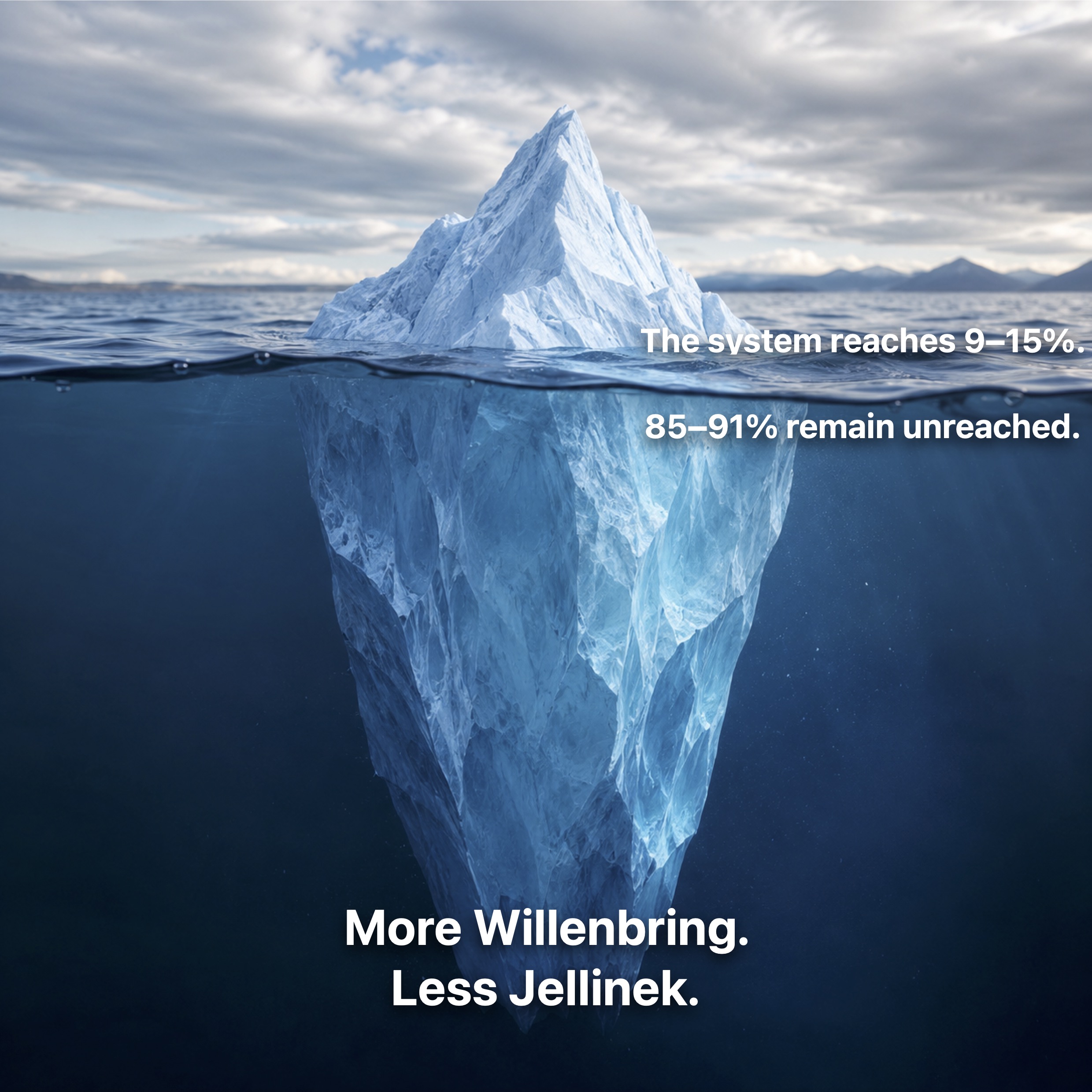
E. M. Jellinek’s model still shapes alcoholism treatment today—even though it’s based on just 98 questionnaires from the most severely affected men. Why Mark Willenbring’s critique of the abstinence dogma and the NESARC data show that 85 to 91 percent of those affected are never reached by this model—and what could actually help them.


Something has to change in how we deal with alcoholism. Jellinek explained the entire world of alcoholism based on just 98 questionnaires from severely affected men in AA care. That baked some serious methodological errors into the treatment of alcoholics. Among them: the questionnaires from women were systematically tossed in the trash. And above all: this study was conducted exclusively on the most severely affected drinkers—yet its conclusions were then applied to everyone.
Let’s be clear upfront: this is not about changing what has kept millions of severely dependent alcoholics sober for decades. For the most severely affected, current treatment methods are a lifeline—even if they were developed on the basis of a deeply questionable study.
Serious methodological flaws don’t just vanish into thin air
The problem is that this study’s flawed methodology obscured the fact that alcoholism comes in different stages—stages that require differentiated approaches. Jellinek’s study was like conducting a hospital-wide patient survey exclusively on people who had to be resuscitated in the ER and then ended up in the ICU. If you did that—and also excluded all women from the study—you’d conclude that every person admitted to a hospital is male and half dead.
Everyone knows that’s not how hospitals work. But when it comes to alcohol use disorder, that is still the prevailing logic in many places: the ICU as the supposedly only way to deal with this disease.
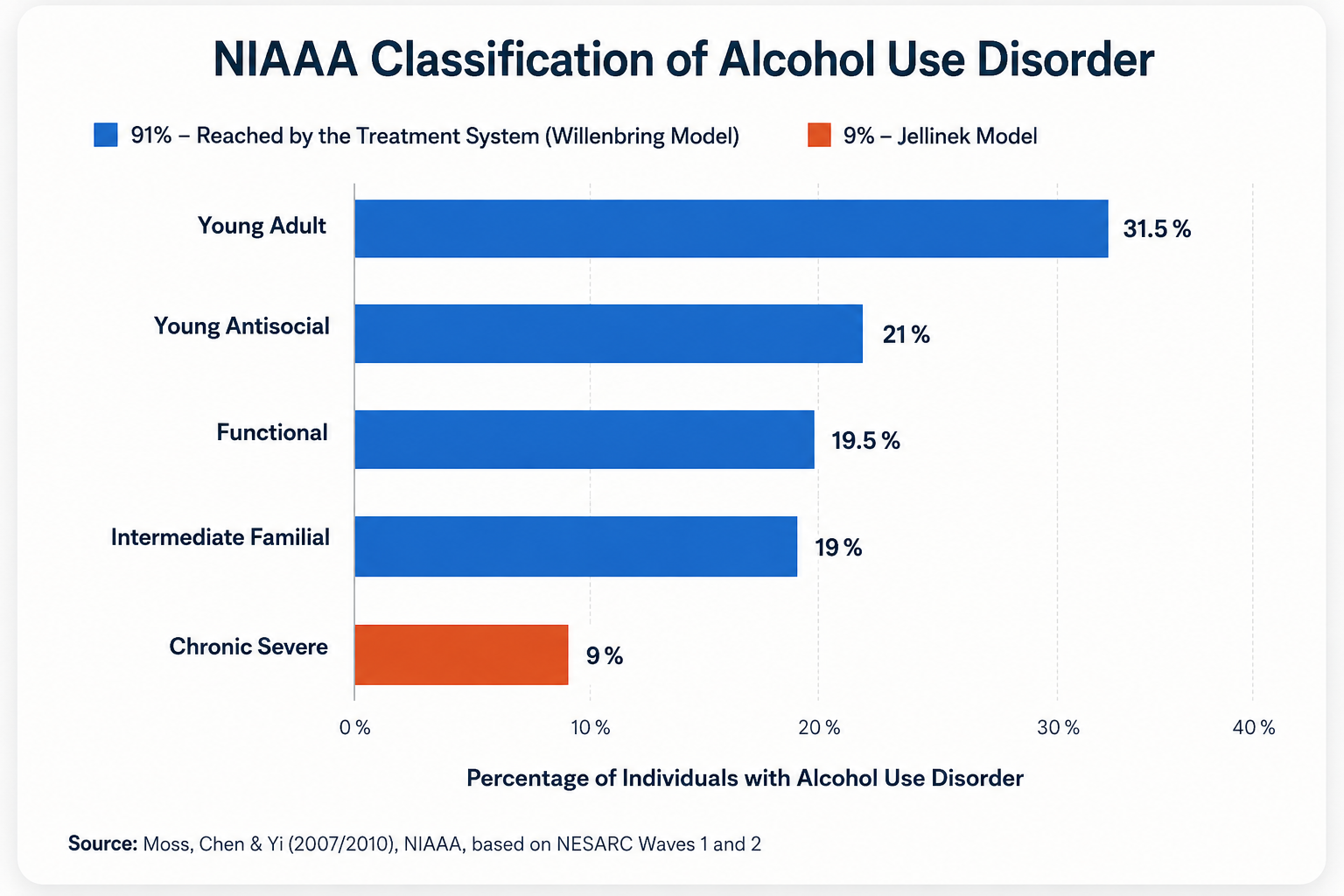
The NESARC study showed long ago that these most severely affected individuals make up just nine percent of everyone with an alcohol use disorder. The other 91 percent don’t fall into that category—but they still have an alcohol use disorder that needs therapeutic intervention.
Here’s the catch: what fits perfectly for nine percent of those affected is the wrong approach for 91 percent—and does nothing for these subgroups. Quite the opposite.
Stop waiting for people to slide into severe alcoholism
Because the current model keeps many people from seeking help early—in a stage before they land in the nine-percent group and actually need massive intervention. Everyone knows that at that point, not everyone can be saved.

Part 1 of our Jellinek series
The Jellinek Model:
A Century-Old Theory Built on Shaky Data Falls Apart
About 30 percent of the adult U.S. population meets the criteria for an alcohol use disorder at some point in their lives. Seventy-two percent of them experience a single episode lasting three to four years that then resolves—most of the time without professional help. The probability of recovering from such a period of alcohol dependence is over 90 percent.
Willenbring’s uncomfortable conclusions
Mark Willenbring, former research director at the NIAAA, drew an uncomfortable conclusion from these data: the entire addiction treatment system is designed for the roughly 10 to 15 percent of affected individuals who have developed—or are on the verge of developing—a severe, chronic dependence. For these people, the system works: AA and other mutual-aid organizations, rehab facilities, 12-step programs, intensive aftercare.
For them, Jellinek’s model as a teaching tool is exactly right: the warning about loss of control, the emphasis on discipline, the hard line on abstinence—these people need that, and intensive training in it helps them.
But 85 to 91 percent of those affected are never reached by this system. They have a mild to moderate alcohol use disorder. They need different options, a different tone, different tools. And for them, Jellinek’s model isn’t just useless—it’s a dangerous obstacle.
Why Jellinek does harm: the slide-through mechanism
Every person who is in the severely affected group today was previously in the mild-to-moderate group. Nobody wakes up one morning suddenly severely alcohol-dependent. There is always a phase before that—a phase in which low-threshold intervention would have been possible, when the neurobiological changes weren’t yet so severe that the road back becomes a brutal uphill battle.
But this is exactly where Jellinek’s model fails. Worse—it actively keeps people from seeking help. Because help in the Jellinek system means: You’re an alcoholic. For life. Incurable. You need rehab, a group, you have to define yourself as sick.
Part 2 of our Jellinek series
Jellinek’s Woman Problem: He Trashed Their Data. It Took Decades to Undo the Damage.

For someone who isn’t that severely affected yet, that’s an insurmountable barrier. So they keep drinking. Or she keeps drinking—because women, thanks to the telescoping effect, move through this phase faster and with less warning time, reaching the stage of organ damage more quickly.
What is still largely missing are low-threshold options for the 85 to 91 percent. Options that don’t start with the label “alcoholic.” That don’t demand lifelong group confessions. That acknowledge a mild to moderate alcohol use disorder is something different from a severe one—and therefore requires different tools. Nutrition-based support. Education about neurobiology. Coaching instead of rehab. Medications. Monitoring and correcting nutrient status.
But these options barely exist. Because the system built on Jellinek was designed only for the worst-case scenario.
The shaky foundation of the Jellinek study
In the first three parts of this series, we laid out what Jellinek’s model actually stands on: 98 hand-picked questionnaires from male AA members, with no control group, no women, produced by a researcher whose academic credentials are unverifiable, and funded by two individuals who presumably expected exactly this outcome.
That doesn’t mean everything that followed from Jellinek’s work is wrong. But he exclusively surveyed the most severely affected. From that, he derived a model for everyone—one that only works for the nine percent who are severely affected. That is the direct consequence of a methodologically inadequate study that should never have been generalized to all.
The uncomfortable question: who benefits?
Bill W., one of the two founders of AA, was famously the first well-known alcoholic to go from miserable to contentedly sober using a nutrient protocol. The physician Abram Hoffer, who worked extensively with high-dose vitamins, played a key role in helping him.
AA more or less showed Bill W. the door over his nutrient concept. In the aftermath, Hoffer in particular spread the view that the rehab and therapy industry had an economic interest in upholding the Jellinek model. A model that defines alcoholism as chronic and incurable generates perpetual demand for treatment. A patient who stabilizes on nutrient therapy and never comes back is less interesting from a business standpoint.
While that logic is easy to follow—there’s no known proof. What is documented, however: a promising lead was never pursued.
What we know—and what should follow from it
The body of research on nutrient deficiencies in alcohol use disorders is extensive—and in most individual findings, methodologically far more robust than Jellinek’s 98 questionnaires. Chronic alcohol consumption disrupts the absorption and utilization of a whole range of micronutrients: B vitamins, magnesium, zinc, amino acids like tryptophan. Other nutrients are consumed at much higher rates during alcohol detoxification, which in turn creates additional deficiencies.

Part 3 of our Jellinek series
Jellinek: Shoe Historian, Con Man, Banana Researcher, and Founding Father of Addiction Medicine
These deficiencies are usually direct biochemical consequences of alcohol consumption. And they amplify precisely the symptoms that drive people to keep drinking—or that paved the way to alcohol in the first place: sleep disturbances, anxiety, depressive moods, inner restlessness.
The fact that this approach has been systematically ignored, ridiculed, or actively suppressed since Bill Wilson’s era is one of the costliest omissions in addiction medicine. The irony: the studies supporting targeted nutrient supplementation are usually far more robust than the one study behind the model that displaced them.
Alcoholism treatment needs to move beyond the Jellinek box
Jellinek pulled alcoholism out of the moral corner. That was his great achievement. But the model he left behind contains a different kind of trap: the trap of false certainty. Either you’re an alcoholic by Jellinek’s definition—or you’re not. Either abstinence or ruin. Either therapy or denial.
But reality is a broad spectrum of alcohol use disorder. Current diagnostics say so. The NESARC data say so. Clinical experience says so. Treatment guidelines in many places have already caught up. There are people who develop a severe chronic dependence and need everything the system has to offer—rehab, AA, aftercare, lifelong vigilance. But there is a much larger group that could find the way back with less invasive, low-threshold measures—before they slide into severe dependence.
This is not a critique of Alcoholics Anonymous or similar organizations. Not a critique of detox clinics. They help people in crisis, and anyone who finds stability there should absolutely hold on to it. But it is a critique of a system that knows only one hammer—and therefore treats every problem as a nail.
Jellinek pulled alcoholism out of the moral corner. Now it’s time to pull alcoholism treatment out of the Jellinek corner.
Frequently asked questions about Jellinek and Willenbring (FAQ)
What is the difference between Jellinek's model and the NESARC data?
Jellinek’s model is based on 98 questionnaires exclusively from severely affected men in AA and describes alcoholism as a uniform, incurable disease. The population-based NESARC study, by contrast, reveals a broad spectrum: 91 percent of those affected have a mild to moderate disorder, and most of them recover without rehab or lifelong abstinence.
Who was Mark Willenbring?
Mark Willenbring was the research director at the NIAAA and analyzed the NESARC data. His central finding: the existing addiction treatment system is designed almost exclusively for the 10 to 15 percent who are most severely dependent—the vast majority of those affected are never reached.
Why can the Jellinek model actually do harm?
People who aren’t yet severely dependent are often deterred by the Jellinek logic: lifelong alcoholic status, rehab, group pressure. This high barrier to entry keeps many from seeking help early—which makes it more likely they’ll slide into severe dependence instead of course-correcting in time.
What role does nutrient therapy play in alcoholism?
Chronic alcohol consumption disrupts the absorption of B vitamins, magnesium, zinc, and amino acids like tryptophan. These deficiencies often amplify the very symptoms—sleep disturbances, anxiety, inner restlessness—that drive continued drinking. Targeted correction of these deficiencies has been largely ignored by addiction medicine since Bill Wilson’s era.
Sources
- Moss HB, Chen CM, Yi H (2007): “Subtypes of alcohol dependence in a nationally representative sample.” Drug and Alcohol Dependence, 91(2–3), 149–158.
- Grant BF et al. (2015): “Epidemiology of DSM-5 Alcohol Use Disorder.” JAMA Psychiatry, 72(8), 757–766.
- Wakefield JC, Schmitz MF (2014): “How Many People have Alcohol Use Disorders? Using the Harmful Dysfunction Analysis to Reconcile Prevalence Estimates.” Frontiers in Psychiatry, 5, 5.
Additional references can be found in the other three parts of this series.
Latest posts on our blog
- Alcoholism Treatment: More Willenbring. Less Jellinek.
- Your Brain Cleans Itself Every Night – Unless You Drink
- Jellinek’s Woman Problem: He Trashed Their Data. It Took Decades to Undo the Damage.
- Jellinek: Shoe Historian, Con Man, Banana Researcher, and Founding Father of Addiction Medicine
- Potassium and Alcohol: Why Your Levels Go Haywire — and Why It Matters
- Red Wine as Medicine — You’d Only Need 263 Glasses a Day
- Alcohol and Breast Cancer — How Much Drinking Really Raises the Risk
- The Beer Belly: The Problem Has Many Nicknames
- The Jellinek Model: A Century-Old Theory Built on Shaky Data Falls Apart
- Seizure: When the Brain Hits the Panic Button
Editorial content is reviewed by Bernd Guzek, MD.
The content on this website does not replace professional medical advice.