Muscle weakness from alcohol is far more common than most people realize. In up to two-thirds of people with a long-standing drinking problem, the muscles of the thighs and shoulders slowly waste away. Doctors call it alcoholic myopathy. This article explains why alcohol targets these muscles in particular, how to recognize the weakness, and how much strength comes back after you quit.

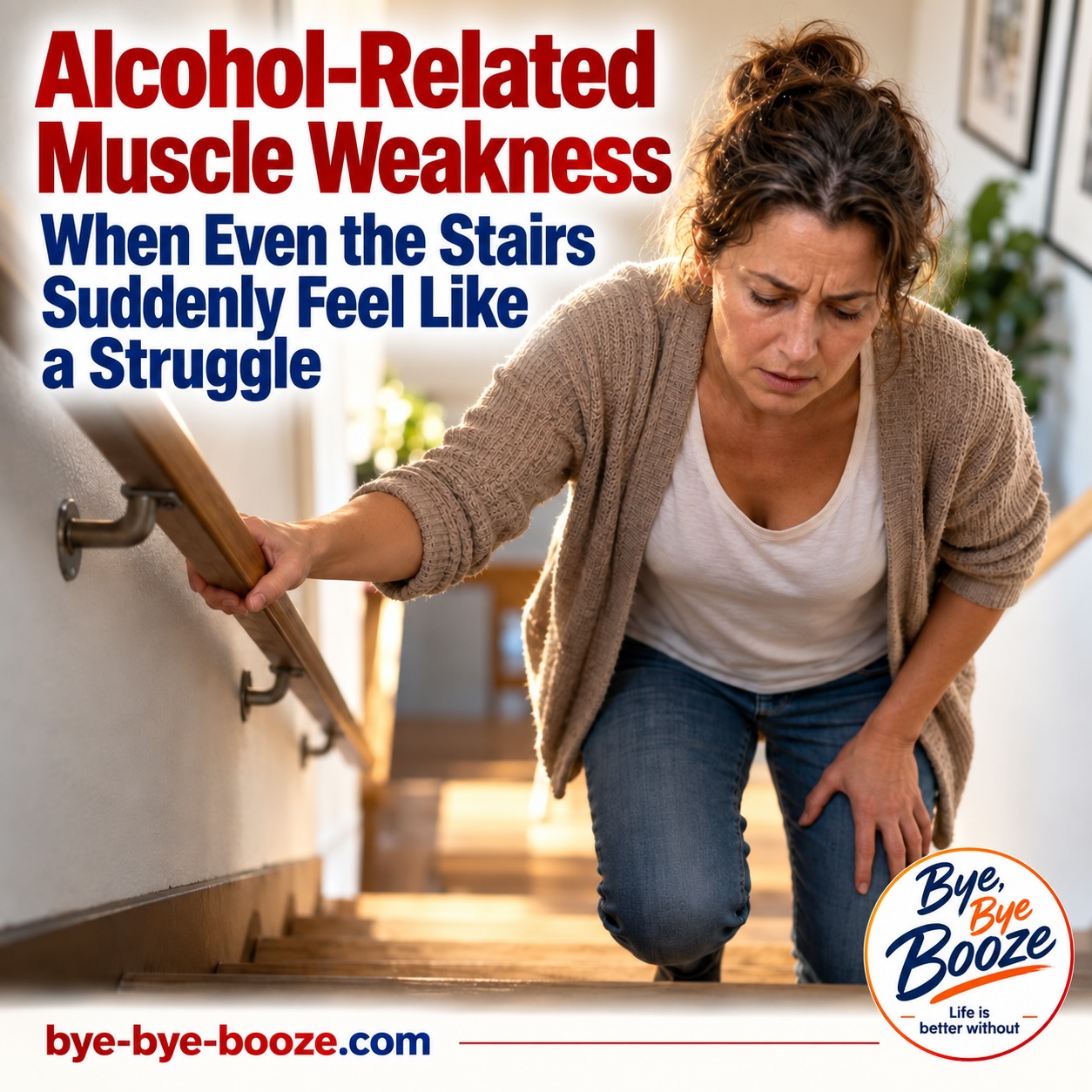
The stairs to the third floor were never an issue. Now your hand reaches for the railing all on its own. Getting up from the deep couch takes momentum—or both hands pushing off your knees. Your arms get heavy while you blow-dry your hair, and again when you put dishes away on the top shelf. Most people who notice this blame age, too little exercise, or their back. Hardly anyone thinks of alcohol.
Yet alcoholic myopathy is one of the most common muscle disorders there is. Myopathy literally means muscle disease—a disorder of the muscle tissue itself. Experts estimate that the chronic form is about ten times more common than the most common inherited muscle disease. Even so, it rarely gets diagnosed.
What is alcoholic myopathy?
Alcohol can damage skeletal muscle in two ways: slowly over years, or suddenly after a heavy binge. The chronic form develops gradually. Muscles get thinner, strength fades, and there’s usually no pain. The acute form strikes after a massive drinking episode, within hours to days, and often comes with severe muscle pain and swelling. Both forms can occur in the same person, sometimes taking turns.
The chronic form is by far the more common one. Depending on the study, it shows up in one-third to two-thirds of people with long-term alcohol misuse. Those affected can lose up to a fifth of their total muscle mass. For a man weighing 175 pounds (80 kg), that’s several pounds of muscle.
Just gone.
Why alcohol goes after your thighs and shoulders
Every muscle is made of two kinds of fibers. Type I fibers are the endurance specialists: slow, tough, and hard to tire out. Think of them as the muscle’s marathon runners. Type II fibers are the sprinters. They deliver short, powerful bursts—like when you push yourself up out of an armchair or take a step. Alcohol hits these fast power fibers hardest.
There’s a second pattern on top of that. The weakness shows up first in the muscles closest to the trunk: the thighs, buttocks, and shoulders. Doctors call this proximal muscle weakness—proximal means close to the center of the body. These are exactly the muscles that carry you up the stairs, lift you out of a chair, and hold your arms above your head.
That makes the staircase your first measuring device.
How alcohol breaks down muscle
Alcohol attacks muscle on three fronts at once: it slows down building, speeds up breakdown, and starves the muscle. A picture helps here. A muscle is a permanent construction site. Every day, old protein building blocks get torn out and new ones go in. As long as demolition and construction stay in balance, the muscle stays the same size.
Construction stalls
Under the influence of alcohol, muscle makes less new protein. Several signals get scrambled at once. The growth factor IGF-1—essentially the work order for the muscle—arrives weaker. At the same time, levels of myostatin rise. That’s the body’s own brake on muscle growth. And acetaldehyde, the toxic byproduct of alcohol metabolism, shuts down the protein factories inside muscle cells on top of that. Researchers at Louisiana State University in New Orleans pulled these mechanisms together in a major review.
The work order apparently starts to falter before you feel anything. Russian physicians found reduced IGF-1 levels in men with long-term alcohol misuse at an early stage—before any loss of strength or fiber wasting could be detected.
Even a single night out leaves a mark
Even one night of drinking measurably dampens muscle building. Australian sports scientists had eight trained men complete a tough session of strength and endurance training. Afterward, they drank either a protein shake or a large amount of alcohol—about 12 standard drinks by Australian measure, or roughly eight to nine US standard drinks. With alcohol, muscle building was 24 percent lower, even though the men also got protein. Without protein, it was 37 percent lower.
The group was small and the dose was high. The principle is clear all the same. If you drink every night, the construction site sits idle every night.
Inflammation, cellular stress, and malnutrition
Chronic drinking keeps muscle in a constant state of inflammation and oxidative stress. Oxidative stress means aggressive oxygen compounds attack the components of the cell. Based on current knowledge, this environment is the single biggest driver of muscle wasting.
Then there’s the deficiency problem. People who drink heavily often eat little and eat poorly, and alcohol also interferes with how the gut absorbs many nutrients. A shortage of vitamin B1 weighs especially heavily. Without thiamine, cells can barely turn sugar into energy—and muscles are among the body’s biggest energy users. That’s why vitamin B1 is essential protection for the brain, nerves, and muscles for anyone who drinks or is just quitting. Low levels of potassium and magnesium also weaken the muscles. And alcohol lowers testosterone, one of the most important muscle hormones.
Vitamin D deficiency is also common in people with a drinking problem, and on its own it weakens the muscles close to the trunk. A low phosphate level can make muscle cells even more prone to breaking down. To learn more about why thiamine matters so much, read our article on how alcohol drains your vitamin B1.
Muscle weakness from alcohol creeps up quietly
Most people don’t notice anything for a long time. British doctors took thigh muscle biopsies from 151 hospital patients with a long history of heavy drinking. In 60 percent, the muscle tissue showed abnormal changes, most often a loss of power fibers. Whether someone complained of muscle problems said very little about what the biopsy showed. The body compensates for a long time. Only when the reserves run out do the stairs suddenly get hard.
What matters most is quantity and duration. The more alcohol a person has consumed over a lifetime, the weaker the muscles become. Russian researchers found that chronic myopathy usually only develops after about ten years of alcohol misuse. So the word “suddenly” in the headline is only true for how it feels. The breakdown itself took years.
Women get hit sooner
Women are more sensitive to alcohol’s muscle-damaging effects. That’s what a study from the Hospital Clínic of Barcelona, published in the journal JAMA, showed. The doctors examined 50 women and 100 men with alcohol use disorder, none of whom had reported any symptoms. Over their lifetimes, the women had consumed only about 60 percent as much alcohol as the men. Yet muscle disease was just as common among them.
Half of the women were measurably weaker, and in half of them biopsies showed myopathy. Among the men, the figures were 39 and 45 percent. The same study also frequently found damage to the heart muscle in both sexes.
The acute form: When muscles break down after a binge
Acute alcoholic myopathy can be a medical emergency. After a heavy binge—often combined with lying in the same position for hours—muscle cells die off en masse. Doctors call this rhabdomyolysis, meaning muscle breakdown. The affected muscles hurt, swell, and turn weak. From the destroyed cells, the muscle pigment myoglobin enters the bloodstream and travels to the kidneys. There it can clog the tiny filters, all the way to kidney failure. At the same time, potassium floods out of the ruptured cells into the blood. A sudden spike in potassium can throw the heart out of rhythm.
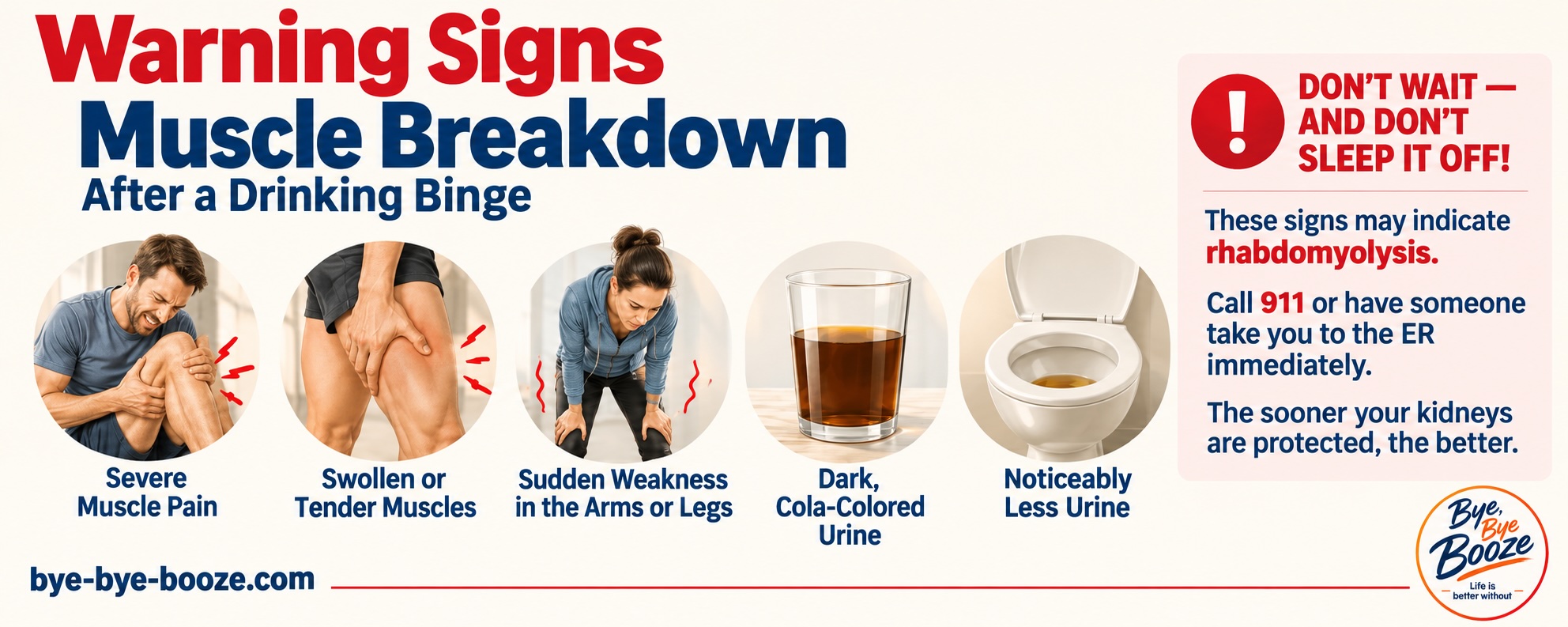
The following symptoms can point to rhabdomyolysis:
- Severe muscle pain
- Swollen or tender muscles
- Sudden weakness in the arms or legs
- Dark, cola-colored urine
- Unusually little urine
Don’t wait it out, and don’t sleep it off!
These signs can point to rhabdomyolysis. Call 911 or have someone take you to the emergency room right away.
The sooner the kidneys are protected, the better.
Milder acute cases usually clear up within two weeks of abstinence. A special form is caused by potassium deficiency, for example after frequent vomiting. It causes painless weakness in the muscles close to the trunk and can be identified with a blood test. To learn why heavy drinkers lose potassium so easily, read our article on potassium and alcohol.
Muscle or nerve? How to tell myopathy from polyneuropathy
Alcohol often damages muscles and nerves at the same time, and both can make you weak. For a long time, doctors even argued over whether heavy drinkers’ lack of strength came from the muscle at all, or whether the nerves were behind it. Today, muscle wasting is considered a condition in its own right, even though it often occurs alongside nerve damage.
For everyday purposes, a simple rule of thumb helps. Alcohol-related polyneuropathy starts at the far ends of the body—in the toes and feet—with tingling, burning, or numbness. Myopathy starts at the center of the body, in the thighs and shoulders. Strength is missing there, but sensation stays normal.
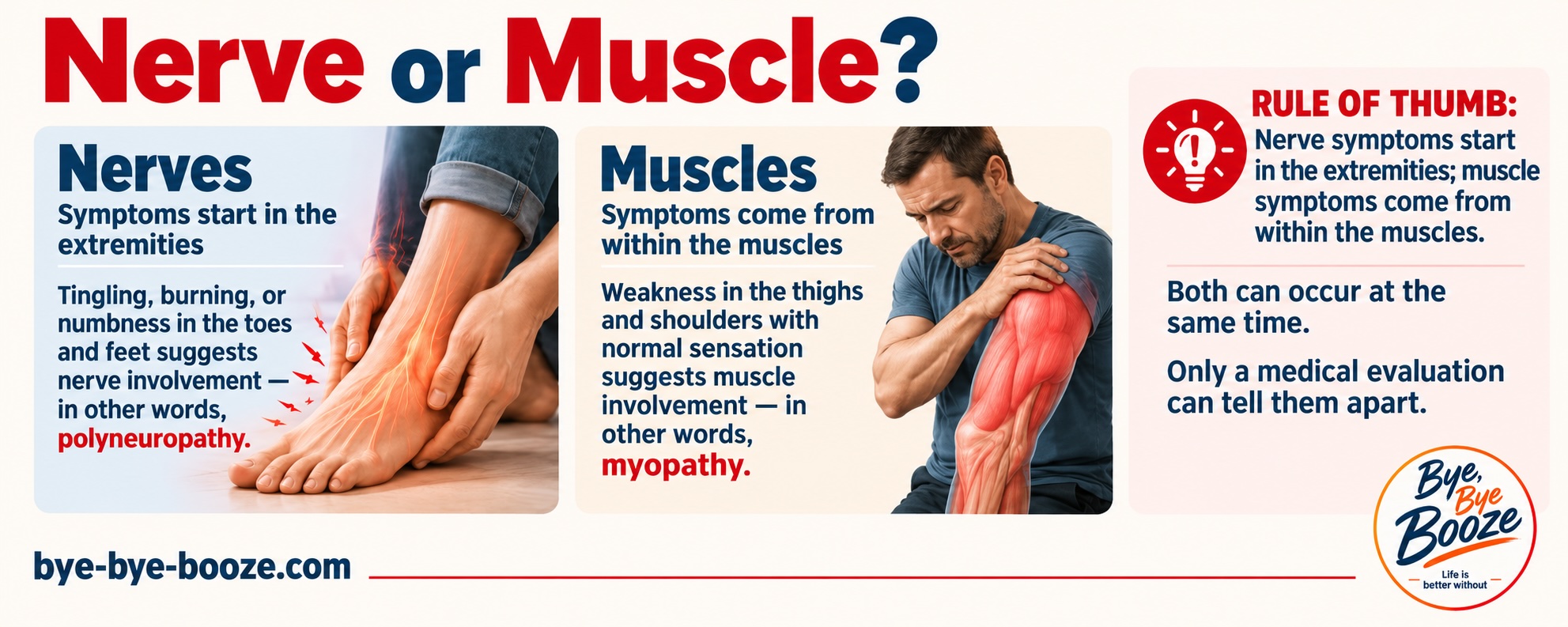
Nerves speak up from the outside:
Tingling, burning, or numbness in the toes and feet points to the nerves—that is, to polyneuropathy.
Muscles speak up from the inside:
Loss of strength in the thighs and shoulders with normal sensation points to the muscles—that is, to myopathy.
Rule of thumb: Nerves speak up from the outside, muscles from the inside.
Both can happen at the same time. Only a medical exam can tell for sure.
How doctors diagnose alcoholic myopathy
The most important tool is an honest conversation about how much you drink. Without that information, your doctor may spend a long time looking in the wrong place. Next comes a strength check—getting up from a squat, for instance, or lifting the arms against resistance.
Blood tests include creatine kinase, or CK for short. This enzyme leaks out when muscle cells break down. In the acute form, CK is often sharply elevated; in the chronic form, it can be completely normal. Potassium, magnesium, liver enzymes, and vitamin levels are checked as well. A test of the muscles’ electrical activity, called an EMG, and a nerve conduction study help tell muscle and nerve apart. A muscle biopsy is rarely needed.
If you’re losing strength in your thighs and shoulders, have your heart checked too. The heart muscle reacts to alcohol much like skeletal muscle does—only with more dangerous consequences. Learn more in our article on alcoholic cardiomyopathy.
Does your strength come back?
After quitting, many people get a good deal of their strength back—but not everyone gets all of it back. The most detailed research on this comes from doctors in Barcelona. Over five years, they followed 30 people with alcohol use disorder who became abstinent and 20 who kept drinking. In the abstinent group, measured muscle strength rose on average from about 41 to 51 pounds (18.6 to 23.2 kg). In those who kept drinking, it kept falling, from about 48 to 40 pounds (21.7 to 18.2 kg), and many developed visible muscle damage only during that period.
That’s one side of the story. The other: Even after five years without alcohol, the abstinent group was still weaker on average than healthy controls. Almost half never got back to normal levels. So chronic myopathy is only partly reversible. The sooner you quit, the more muscle is still there to build on.
In a follow-up study of 58 men, the same team published another finding. Muscle strength also improved in eleven men who cut back to no more than 60 grams of alcohol a day. That’s roughly four US standard drinks—about four 12-ounce beers—every single day. It’s far beyond anything considered low-risk. This study measured muscle strength and nothing else. What that amount does to the liver, heart, and brain wasn’t part of the research.
For your muscles, every drink less counts. For the rest of your body, it’s not enough.
What helps your muscles rebuild
The most important step is to stop drinking. Only then can the construction site get back to work. And to build, it needs materials. Getting enough protein is especially important in the first few months, along with enough calories overall—many heavy drinkers are malnourished beneath the surface.
Muscles also only grow when they’re challenged. Targeted exercises for the thighs and shoulders pay off the most, and the staircase that used to be a struggle becomes your workout equipment. If your heart might be affected too, get the go-ahead from a doctor before you start training.
Deficiencies in vitamin B1, potassium, or magnesium can be detected with blood work and specifically corrected. For a rundown of the nutrients heavy drinkers typically lack, see our overview of nutrient deficiencies in alcohol use disorder. And then it takes patience. Acute changes resolve within days to weeks; rebuilding after the chronic form takes months, sometimes years.
Key takeaways
Muscle weakness from alcohol affects up to two-thirds of people with a long-standing drinking problem. It starts in the thighs and shoulders, which is why it first shows up on the stairs and when getting up from a chair. Alcohol slows muscle building, drives inflammation and breakdown, and makes nutrient deficiencies worse. Women develop it at lower amounts of alcohol. After a heavy binge, acute muscle breakdown can threaten the kidneys. After quitting, a large share of strength comes back—though not completely for everyone. The sooner, the better.
Does the thing with the stairs sound familiar? Swap stories with others who’ve been there in our community forum.
Frequently asked questions about muscle weakness from alcohol
Can alcohol cause muscle weakness?
Yes. Muscle weakness is one of the most common consequences of a long-standing drinking problem. Depending on the study, so-called alcoholic myopathy affects one-third to two-thirds of people with long-term alcohol misuse. It usually starts in the thighs and shoulders and develops over years.
How do I know if I have alcoholic myopathy?
Typical signs are that climbing stairs, getting up from a low armchair, or lifting your arms over your head become more and more of an effort. Strength is missing mainly in the muscles close to the trunk, while sensation in the arms and legs stays normal. Tingling and numbness in the feet point more toward polyneuropathy. A medical exam can sort it out.
Will my muscle strength come back if I stop drinking?
For many people, strength improves significantly after quitting. In a five-year long-term study, however, almost half of those who stayed abstinent never got back to fully normal levels. The sooner you quit, the more muscle is still there to build on.
When is muscle weakness after drinking an emergency?
Severe muscle pain, swollen muscles, and sudden weakness after a heavy binge can signal acute muscle breakdown, known as rhabdomyolysis. Dark, cola-colored urine is a particular warning sign, because the released muscle pigment can damage the kidneys. In that case, call 911 right away or go to the emergency room.
Are women more vulnerable to muscle damage from alcohol?
Yes, women are more sensitive. In a study from Barcelona, women with alcohol use disorder had consumed only about 60 percent as much alcohol over their lifetimes as the men, yet muscle disease was just as common among them. Half of the women studied were measurably weaker, even though none of them had reported any symptoms.
Does alcohol slow muscle growth from working out?
Yes. Even a single night of drinking can measurably dampen muscle building after a workout. In an Australian study, it was 24 percent lower after heavy drinking, even though the athletes also got protein. If you drink regularly, every workout is fighting against your own muscle construction site.
References
- Simon L, Jolley SE, Molina PE (2017): “Alcoholic Myopathy: Pathophysiologic Mechanisms and Clinical Implications.” Alcohol Research: Current Reviews, 38(2).
- Urbano-Márquez A et al. (1995): “The greater risk of alcoholic cardiomyopathy and myopathy in women compared with men.” JAMA, 274(2).
- Estruch R et al. (1998): “Natural history of alcoholic myopathy: a 5-year study.” Alcoholism: Clinical and Experimental Research, 22(9).
- Fernández-Solà J et al. (2000): “Low-dose ethanol consumption allows strength recovery in chronic alcoholic myopathy.” QJM, 93(1).
- Parr EB et al. (2014): “Alcohol ingestion impairs maximal post-exercise rates of myofibrillar protein synthesis following a single bout of concurrent training.” PLoS One, 9(2).
- Martin F, Ward K, Slavin G, Levi J, Peters TJ (1985): “Alcoholic skeletal myopathy, a clinical and pathological study.” Quarterly Journal of Medicine.
- Nemirovskaya TL et al. (2015): “Development of clinical and morphological signs of chronic alcoholic myopathy in men with prolonged alcohol intoxication.” Human Physiology, 41(6).
More on Bye, Bye, Booze
- Tingling and Numbness in the Feet – Recognizing Alcohol-Related Polyneuropathy
- Alcoholic Cardiomyopathy – When Alcohol Attacks the Heart Muscle
- Nutrient Deficiencies in Alcohol Use Disorder: Why Symptoms Persist After Quitting Alcohol
- Potassium and Alcohol: Why Your Levels Go Haywire—and Why It Matters
- Sobriety Dictionary: Beriberi
- Chronic Fatigue and Alcohol